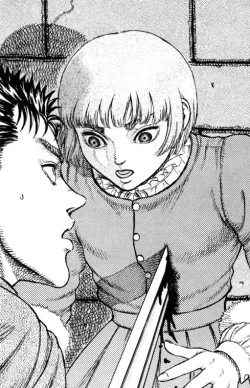
I have a confession to make: Berserk
is in fact the best fantasy story ever written. Retire your Lord of the Rings
, put Harry Potter
to bed, throw Game of Thrones
in the garbage. Berserk
is the absolute cream of the crop. Deep characterization, beautiful artwork, gruesome violence and a fully developed dark medieval world with some of the most striking grey morality seen in comics. It's a true masterpiece, one which I can totally accept waiting years upon years for twenty pages of very little plot development just to get more. Well, unless you're a poor soul whose first experience with the series is through the Golden Age
trilogy movie series. Please don't do this to yourself.
Because of the size of this review I'll be splitting it into separate posts for each movie. If you actually want to watch the film trilogy for some reason or intend to read the excellent Berserk
manga, I suggest you do so now. If you're unsure of how to break into the series, that's the route you should take. There will be spoilers for volumes 3-13 of the manga and the entirety of the 1997 anime. If you're still here, then please enjoy.
The Egg of the King
The first film of the trilogy,
The Egg of the King, kicks things off with Guts in his mercenary group laying siege to a castle. I don't want to harp on too much about the big omissions made in the movies and would rather judge most adapted work on their own merits, but this film trilogy has a bad tendency of cutting extremely important details to shove in very poor CGI set piece moments--as it turns out, the first movie opens with this exact issue. Let me explain:
Berserk, in both the manga and original anime, begin
in media res with Guts, as the Black Swordsman, slaughtering his way through the Apostles in his quest for vengeance.
Establishing a fantasy series with the extraordinary is not simply an aesthetic choice; it's designed that way specifically for the audience to know exactly what they're getting into. In the case of
Berserk, we know Guts is on a murder rampage fighting enormous monsters with a giant sword before stepping back and building the world with the Golden Age arc. Note that this does cause tonal problems in the first movie, and not in a particularly interesting way.
Game of Thrones has a similar set-up as the very first thing seen are the wights, even though they're not a plot point until nearly the end of the first season/book. A viewer already needs to suspend their disbelief enough as is with a fantasy series, and bludgeoning them with an even more fantastical element does nothing to help that. As an added bit of hilarity with this analogy,
Game of Thrones also
just introduced an out-of-place tone annihilator that I'm still coming to grips with because, after six seasons, it's throwing in new concepts that seem out-of-place in the story.
This isn't a new concept; in fact, the strongest example behind this establishment is from the grandfather of fantasy, JRR Tolkien. In an essay, Tolkien wrote "[an author]
makes a Secondary World which your mind can enter. Inside it, what he relates is 'true': it accords with the laws of that world. ... The moment disbelief arises, the spell is broken; the magic, or rather art, has failed." So if you begin a story as a strictly low fantasy about orphaned child soldiers and medieval conflicts, throwing in evil Satan monsters from Hell out of nowhere ruins that internal consistency. It's like having a low fantasy in a setting where magic is dying and dragons are extinct suddenly introducing a convoluted time travel Grandfather Paradox. If your setting doesn't follow the rules established early on it becomes harder for the audience to suspend their disbelief; starting Berserk anywhere but the the Black Swordsman arc is a failure, in my opinion.
So when the first
Berserk film opens with an irritatingly loud and ugly CG castle siege that drags on far too long and serves only to put Guts in front of Bazuso, expectations are justifiably low. These enormous battles occur often enough in the series and wasting too much time with one at the very beginning can only cause fatigue with later castle sieges. Considering the first two films are barely over an hour long, wasting time is hardly a great way to
start the series. Then again, it's kind of hard to not call this thing a waste of time. The 1997 anime already exists and the movies begin with less content than that series, and by the end there's very little you wouldn't get otherwise. All the films needed to do was fill in the gaps but we're already wasting several minutes for a battle nobody ever wanted to see. As a comparison, the first anime opens with Guts as the Black Swordsman with his Dragonslayer sword laying waste to an Apostle before the scene flashes directly to Guts facing off with Bazuso. It's a better introduction to the story as a whole and wastes little time, unlike this thing.
Guts then just kind of leaves his mercenary camp, ignoring a vital character detail in which he hates being touched. That's fine though, because the film trilogy entirely removes that aspect of Guts's character. In fact, most characterization is thrown out the window in the film trilogy. Characters like Corkus and even minor characters like Gaston, who barely qualified as a character to begin with, are completely thrown in the background and do very little aside from fight and act like a one-dimensional cartoons. Part of the reason
Berserk is so widely regarded as transcending its medium is its characterization; even if we see them very little, in the manga we can tell exactly how someone like Pippin or Corkus will act because their characters are developed. In the film trilogy Corkus just attacks Guts because he wants to and Guts just leaves the mercenary camp because he feels like it, there's no reason for any of these characters to be near each other aside from contrivances.
Guts easily defeats the Hawks before being handily beaten by Griffith, and in his ensuing feverish nightmare the viewer is given a tease about Guts's past. In my nightmares I'm not actually the best, smartest and strongest person who everyone admires. They're waking nightmares because it's every second of my life. What,
Berserk? Oh, so Guts has these terrible nightmares that are apparently directed by an idiot who thinks the viewer can tell what this out-of-focus blurry mess actually is.
Can you tell what's happening here? Not
if you haven't read the manga!
So in a baffling display of complete ineptitude the film trilogy omits Guts's very tragic backstory involving patricide, the coolest tree ever, rape, and disease--although for some strange reason the rape is still shown without context. The only way to know what happens to Guts and why he hates being touched is to read the manga, but then what is the point of this film trilogy if not to fill in the blanks left by the original anime? I'd hate to posit the theory that it's entirely to get the viewers prepared for the disappointment of ugly CG in the upcoming Black Swordsman anime adaptation. Actually, I'm going to posit it anyway. This film series is supposed to replace the original anime, but all you get out of these first two films, at least, are a bad adaptation of the Golden Age.
The only people who have any idea what's going on in that above flashback are people who read the manga, but if these movies are supposed to catch up newcomers for the upcoming series then what is the point of including them in the first place? Guts also has nightmare flashbacks to Gambino and his past in Gambino's mercenaries, but there's absolutely no context. You can hardly tell what's going on in the flashbacks which entirely defeats the purpose. Maybe if they'd cut out the boring three minutes of fighting that started off the movie they could have left it in. Whoops. As an aside, in the manga this all comes full circle when Casca and Guts have sex, but we're not there yet. Just so you know, that's been omitted as well. Before we get there we have to parse a lot of elbow-deep stupid butt butter poopoo crap stupid

There's something I need to point out here after re-watching the film. There actually is some dialogue that gives greater context to the flashbacks, but I swear that you absolutely cannot hear anything because it's so muffled. So congratulations, Egg of the King. I finally deciphered your annoying flashback puzzle. I guess next time I'll watch the movies at three thousand percent volume with subtitles to make sure I don't miss critical plot details. Good job!
So after some annoying flashbacks with no context that are never, I seriously mean never explained during the course of the film trilogy, Guts is formally introduced to the Band of the Hawk. Guts is embarrassed to learn that he was kept from developing a fever with the help of Casca, a female member of the Hawks who was commanded to keep him warm after falling to Griffith in battle. Needless to say, she's pretty ashamed of having little choice in the matter and punches Guts in his wound before stomping off. He is forced to become a member of the Hawks after a second crushing defeat by Griffith, an ambitious young man who is given far more development than just about anyone in the entire series--at least, if you're only watching these movies.
At this point in both the 1997 anime and manga Guts is charged with leading a surprise attack on an enemy camp to judge his effectiveness, and after pleasing Griffith with his instinctual knowledge of battle Guts is promoted to captain of the Raiders, the Hawks' vanguard. Not only does this give the audience a great deal of character development in regards to nearly every member of the Band of the Hawk, what their roles are, how they interact and just how great of a tactical genius Griffith actually is, it also serves to give a bit of development to the Hawks who aren't entirely convinced by the inclusion of Guts in the group. It's a great character moment and serves as an interesting change of locale as the battle is largely a covert mission at night. Instead, in this movie Guts is just thrown into his spot at the Raiders and a few years pass.
I hate that this scene was cut, not in the least since it was cut to shove in another protracted battle scene in the middle of an open field with ugly CG. It's the same as every last battle in the Golden Age arc and after the first one they really start to blend together, and in the spirit of the films important character moments are thrown aside to show off laughable CG.
Casca nags at Guts--one of her few character traits--as she thinks he's reckless and is putting the Hawks in danger, and Griffith steps in to explain Casca's annoyance. At this time the larger conflict is introduced: Midland has been at war with Chuder in The Hundred Year War, and Chuder is gaining the upper hand. Griffith is knighted and his Band of the Hawk is semi-officially absorbed into Midland as the kingdom's premier army. As a quick note, the films at least do the honor of going into small detail over the different types of armies; for example, there's the Band of the Hawk, of course, but there's also the White Dragon knights, the Holy Iron Chain, Blue Whale Heavy Infantry, Black Ram Iron Lance--just about every army band has a specific title. It's a neat bit of world building that's so minor I'm surprised the film even took the time to bother, but it's all there. The Band of the Hawk, as it turns out, is perhaps the best of all of these army bands and the king of Midland is not lost on this fact. Many nobles take note of this and hold private meetings to discuss the Hawks' meteoric rise in power, although this really doesn't go anywhere in the films as the primary instigator behind the conspiracies, Minister Foss, is completely absent from the film trilogy. He's actually a very important character and without him, much of the undercurrent of the tension during Golden Age is entirely cut. Foss is a character that Griffith can't just deal with in battle, he's a tactical genius much like Griffith and it was always interesting to see the two moving their own chess pieces as the story progressed. But no, that's completely absent and it really does feel like something important is missing.
Before I move on, I want to bring detail to an annoying detail lost in the film trilogy: small moments with the Hawks that are mostly absent. These can range from funny to somber and the audience gets to really know the Band of the Hawk and all of its members, and you can really see the lack of development with them as the films progress. It's kind of a minor point and you get some of that as the films move on, but these movies are so down in the dumps and moody that a little bit of the tension deserves to be released every now and then. As it is, the films all have a problem with the plot being torpedoed into the next big scene from the manga, and watching a condensed version of a series I know so well does get jarring without any of these camp sections. Like many times these movies scenes are mashed together seemingly at random; for instance, right before Casca nags Guts and calls him a mad dog--a poignant detail you probably should keep in mind for later story arcs--an earlier camp scene is crammed here without much purpose and just feels terribly awkward.
During the Hawks' campaign, several soldiers are held up inside a castle and the Hawks are left without a word from them until one soldier escapes to tell them that a legendary warrior named Zodd is inside slaughtering literally everybody. In a frenzy, Guts charges inside and matches Zodd in blows. The latter suddenly mutates into a giant monster, tossing Guts around like a ragdoll. I like this scene. Zodd looks great and most of the scene is a direct adaptation of the events in the manga. There's good direction in the action and you can really see how intimidating Zodd is in his Apostle form. Griffith joins Guts and the two are injured; before Zodd can deliver the killing blow he notices a trinket Griffith wears and leaves Guts with an ominous warning of his death.
While I do enjoy this scene as a returning viewer, I just can't imagine what a newcomer to the series, whose first experience with Berserk is this movie, would think about this scene. It really is well-made and they translate the pages of the manga very well, but it's such a dramatic tonal shift that the stakes are completely shifted at once. More than that, it makes the Zodd moment seem like a complete swerve that seems to have little relevance to the story. Worse, this moment is essential to the rest of the story arc, so there's no way around it--so why not begin the movie with just a brief glimpse of Apostles like this? It's not like there's a shortage of them.
Just use this stupid loser, I don't care.
The shot at the beginning of the third movie would have been great to start this particular film, and it would definitely make the transition to the Zodd scene smoother. But whatever. I'm sure other people love this movie because of this. They're wrong, but it's cute that their brains still work.
After this Guts and Griffith have a quiet moment in Midland castle; Griffith finally shows his trinket, the Behelit (or, the Egg of the Supreme Ruler), which he received by a creepy old lady in his youth. He explains that, in exchange for something precious, the owner of the Behelit can achieve their deepest dreams. This moment also crams two entirely different scenes together, and all the details become difficult to parse with so much being thrown at the audience at once. There's also an entirely new scene here that I just adore: while Guts is inspecting the Behelit, its eyes begin to open. Horrified, he throws the Behelit in the air and falls back. Griffith catches the Behelit and, seeing Guts fall, turns around to grab him. Guts leaps up to grab his sword and sighs in relief.
Everything about this small character moment is unbelievably charming that I have difficulty determining if this was something Miura wanted to add or if the director had a moment of "not being an idiot" and created a masterful ten seconds of film on his own. Guts reacts with shock to the Behelit and, despite being at the peak of physical fitness, has a short bout of clumsiness. We see that Griffith is a capable leader who keeps the symbol of his ultimate goal, the Behelit, within his reach at all times. He has little trouble catching it in midair, and when Guts falls Griffith effortlessly turns and catches him despite both of their injuries. Griffith seemingly cares for his ambition and his soldier at the same time and, even though it could cause stress to his healing body, he still takes time to consider his men. Guts, on the other hand, has a negative reaction to the fantastical element of the Behelit and is nearly out-of-character in his clumsiness. While nearly falling off a staircase, he spurns Griffith's help (if he even noticed Griffith reaching for him at all) because the most important thing in the world to him, his massive sword, might fall to the ground and get scraped.
We see every single detail about both of these characters in a matter of seconds without ever having to be told their motivations or beliefs. Simply interacting with the environment, each other, and their belongings, we see through their actions and expressions what these characters cherish. Griffith grabs the Behelit out of the air first and even holds it close to himself for a brief moment before noticing Guts falling, and Guts ignores Griffith's help to reach out for the most important thing in the world to him. It's such a brilliant and poignant scene that I'm still baffled that it's in such an otherwise poorly slapped-together movie. This is the kind of stuff Berserk is at its best with: in a few seconds and with nobody speaking, we understand everything about these two. I'm a bit disappointed that the bath scene is omitted and much of it is halfheartedly grafted into this part of the film. That would have also helped to ease the tonal shift with Zodd's introduction since it occurs earlier, and up to that point we're given little knowledge of the Behelit as well. In any case, this is a great moment, and the rest of the film follows suit by actually following the manga very closely.
The king of Midland, a few noblemen, and Princess Charlotte pass by after the king exchanges words with Griffith, who at this point has been promoted to the title of Count. Charlotte trips and, seeing an opportunity to get close to her, Griffith catches her. One of the noblemen, Julius, takes umbrage with this act and chastises Griffith for laying a hand on the princess. Following this exchange, the Hawks are given an opportunity to assist in boar hunting with the royal family; Julius hires an assassin to poison Griffith, though this attempt fails when the Behelit mysteriously blocks the arrow. There are a few cute little moments with Griffith and Charlotte, but truth be told there's very little else between these two characters. I'll get into that more with the following movie, but in the film trilogy there are few interactions between Griffith and Charlotte and he really does go out of his way to charm the pants off her. Well...we'll get to that.
Griffith tracks the poison back to Julius and orders Guts to assassinate him in turn.While discussing the assassination there's also a funny scene omitted from the manga with Griffith passing Guts some Kama Sutra-esque sexual book and it gives the two some juvenile camaraderie, especially given that they're both still teenagers at this point. It breaks the dour tone of the series just for a little bit, and like the camp scenes you can clearly tell that something is missing. So Guts just decides to go murder Julius for fun and while there brutally murders Julius's son, Adonis. This is a defining moment for the character and begins the trend of his doubt for Griffith--it also reinforces that Guts is still a human who makes stupid mistakes. You can't really help but feel bad for Guts despite the fact that he just murdered a child; Guts is still a teenager himself despite looking like a bulking colossus, and this moment weighs on his conscious in fairly obvious ways as the story unfolds. Before he can collect his thoughts the guards find him and attempt to halt his progress, though most are slaughtered.
Another scene here that I absolutely despise being cut is Guts reflecting on Adonis and Julius's relationship before going in for the kill. Julius is a demanding parent who berates Adonis for being rather terrible at swordplay, and this reminds Guts of his past in Gambino's mercenary camp. He feels sorry for Adonis and empathizes with the little kid because he sees some of himself in him, so when he ultimately murders Adonis by pure accident he puts himself in the shoes of a monster. Guts dreams of himself as Nosferatu Zodd murdering a version of himself as a child, and it all comes back around to this one pitiful moment. The film completely skips all of this and I'd consider it a failure just for that alone. This is probably the most important development in Guts's character during the entire Golden Age arc and I can't help but feel it was skipped for some stupid CG battle. Hope you're happy, idiots.
I should mention here that the film actually rectifies one of my biggest pet peeves with the manga: in the original, Guts is one of the only people in the world who is shown effortlessly swinging around a weapon as huge as his sword. While he does clear out a majority of the guards, it should have been a no-brainer to connect the assassination with the only guy in the entire castle town who actually has a weapon that could cause such devastating wounds as Guts's sword. Instead they have him wielding a normal longsword and he's shown to be as proficient with it as he is with his normal greatsword, and I can't even begin to explain how grateful I am that they took the time to fix this small detail. In a world as consistent as Berserk, I always thought that Guts never once being questioned as the assassin was a massive oversight.
Who could possibly have stabbed Adonis
with a sword so massive it obliterated all of his internal
organs in one swing? Eh, whatever, guess we'll never know.
Guts falls into the castle sewers and interrupts the Hawks during a party. Casca begins to berate him for disappearing without a trace, but is visibly upset when she notices that Guts is covered in wounds and barely responsive. She tells him that Griffith is attending a party with nobles and attempts to stop him from going, but the barely-conscious Guts pushes on anyway. Griffith is courting Charlotte near a fountain and Guts nearly approaches the two, but Casca chastises him for potentially embarrassing Griffith in front of the nobles that are the key to his promotion; still, she tears her shirt to help cover Guts's wounds. Guts catches part of Griffith's conversation, in which he foolishly tells Charlotte that he could never consider his soldiers friends as they have no ambition of their own, and that a true friend would never follow orders blindly. Guts, crushed by the realization that Griffith only sees him as a tool, slumps away in defeat while Griffith grins upon hearing the news that Julius and Adonis have been found dead. Casca, overhearing the announcement, takes a final look at the wounded Guts as she realizes what he's just done. The first film in the trilogy ends with the expressions on the three main characters' faces: ambition with Griffith, concern with Casca, and defeated contemplation with Guts.
Verdict
I'm always okay with more Berserk, but this first film left a bad impression. Many scenes are cut and battle scenes are seemingly extended. The battles themselves are drab and ugly, consisting mostly of bad CG and overhead shots of generic mounted combat. It feels like a failed attempt at cashing in on the Lord of the Rings high fantasy war story, but Berserk has never really been about this stuff. Sure, fighting in Berserk is some of the best you'll ever see in the medium, but the merit of this being a long-running manga series is that there are no real time restrictions. In translating the hectic, sprawling political movements to a movie that's barely over an hour much of the depth is entirely cut away, especially in terms of small character moments that drive the Golden Age arc. The audience at this point should deeply care about the main cast of the Hawks, but there's nothing really here to grow attached to other than the three main characters. This movie is clearly intended to catch up older viewers and close gaps left by the cliffhanger ending of the original anime, but that doesn't mean it has to be a bad movie in the first place. This should have either been its own television series or the movies themselves should have been longer, because for this film there's nothing the viewer can gain by not watching the original series. Even small hints at omitted details, such as the Donavon subplot, are cut away so drastically that what should have been a defining moment for Guts is instead relegated to a blurry picture with muffled voices that make no sense without context.
This is a hard movie to recommend, especially considering it ends on a cliffhanger and serves mostly to reacquaint the audience to the series before the new anime begins later this year. If you can, just read the manga. If not, go find the TV show. This first movie, at least, offers very little for a returning Berserk fan, and for a newcomer, you're missing out on some seriously good fantasy drama.