That criticism doesn't apply to The Battle for Doldrey, the second film in the reboot trilogy. Bigger, flashier, uglier, and missing all the subtlety of Berserk, this film instead capitalizes on the notion that we really just need to get to the third film already so let's get through this as quickly as possible. What ensues might be the biggest regretful purchase of my entire life, a sequel that doubles down on all the faults of the original while cramming as much worthless CG as possible. Let's get down to business--someone's gotta put effort into this movie, right?
Big Dumb Action
As I mentioned, one of the biggest flaws of the first Golden Age film is the near-total excision of many of the tragic scenes which give Berserk its emotional weight. When going into this movie my initial thought was "it cannot be as bad as the first." Some of the most iconic Berserk moments occur during the events of the film, and a fan of the series only needs to hear that the film adapts the Golden Age chapters starting with the Hawks' assault on the fortress Doldrey and eventually ending on Griffith's fall from grace to get excited for the political intrigue to come. These chapters are actually my favorite part of the Golden Age as we not only get to see the inner machinations of the politics in the setting, but we also get very interesting battle scenes as well as many character arcs being fleshed out--both the Band of the Hawk and the political leaders of Midland and Chuder are explored in-depth. Basically, Battle for Doldrey is the cornerstone of the Golden Age; without this span of chapters the emotional punch of the Golden Age finale is severely lessened.
After the credits, Battle for Doldrey wastes no time in disappointing the viewer. Rather than the intricate political scheming between the queen of Midland, Foss and Griffith, the movie rushes straight into the first major battle of Doldrey with Griffith's Raiders leading the Hawk into battle. Foss was removed from Julius's schemes in the first film and I was hoping that at least he'd make an appearance starting from this point, and his exclusion from this film means that several of the most important emotional anchors holding down the Golden Age story arc have been entirely lifted. As a reader of the manga or even someone who has viewed the 1997 anime, this is likely going to be the film loses much of its weight. Foss becomes a major player later in this point of the story, the Queen of Midland is important for Griffith's development, and the loss of her initial encounter with Griffith means that he no longer has any political strife in the story.
 |
| Arguably Griffith's most terrifying display of strength is completely absent from this film. |
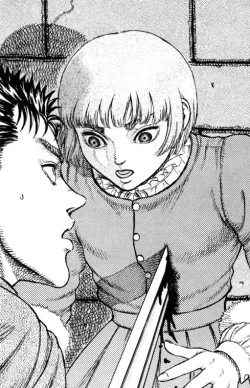
Even more startling than this omission is the removal of Charlotte and Griffith's courting. Before leaving Midland Charlotte gives Griffith a small magnet in the shape of a knight; she tells him it's good luck and that her similar magnet will be drawn to his when he returns from battle. It's a naive and rather cute moment from a character who is basically just drawn in to Griffith's political schemes without much say in the matter, and this small gesture is a small nod to the audience that Griffith has won her heart over after his attempts in the previous film. It may not seem like much, but it gives depth to their relationship which makes later events in the film utterly baffling without their inclusion. And just remember, these three paragraphs come from seconds of starting the film. Get ready, we've only just begun.
 |
| "The aptly-named Sir-Not-Appearing-In-This-Film" |
Casca is having problems of her own as her period is starting on the battlefield and gets into a scrap with the chauvinist Adon, a comic relief villain who loves shouting his attacks out as if this were an anime or something. Adon effortlessly wipes out some Hawk redshirts and taunts Casca before Guts appears to drive him back. Casca cuts the fight short after passing out off a cliff; Adon shoots Guts with a crossbow before he can pull her up and the two tumble into a nearby river. Before I continue I want to remark on just how impressive the visuals are for this movie, especially at this point in the pouring rain as Guts and Casca are drenched after the brutal dive from the cliff. We're not talking about this from a visual standpoint and I don't want to harp on about such a small aspect, so I just wanted to get it out of the way here.
Griffith hears a report that Casca and Guts have gone missing and a soldier warns Griffith to not cut their forces before the scene goes back to Casca and Guts in a cave. There's a cute little moment where a bug crawls on Casca's head and Guts delicately sets it aside, a detail that's new in this film, and casually strips off her soaked clothes. He realizes she's on her period and remarks on how difficult it must be to be a woman. The camera pans out on one of Berserk's most iconic moments: Guts, taciturn with one hand on his sword and another around a nude Casca, watching diligently for soldiers as he repays Casca for doing the same when he first met the Hawks.

I love this scene and it's honestly one of the first that comes to mind when I think about the Golden Age, and it's done more or less with the respect its due here. My only problem stems not from the cinematography itself but rather how Guts is portrayed in general in the film. Guts is still a teenager at this point in the story, still insecure and very young. This is the most intimate he's ever been with a person, and the image of him doing this as a teenager while still traumatized by Donavon makes him look more mature than his age. In the film, Guts just looks like normal Guts. Huge, intimidating, square-jawed and built like a brick wall. The innocence of youth is all but gone because he looks like he's in his thirties. What should be a tender moment between youth is less impactful.
Emotional Roller Coasters
Moving on, another out-of-focus moronic flashback is shown. Casca is beaten and nearly raped by a nobleman before Griffith rescues her, leaving her with his sword to test her resolve. She murders the nobleman and the flashback ends. Casca wakes up and is less than pleased with Guts in a humorous exchange as she throws pieces of armor and even her sword at Guts. The humor is drained when Guts callously brings up her position as a woman, which causes her to break down and spill her
guts
about why she hates him.
In a shocking display of ineptitude the film skips Casca explaining her past to Guts. I don't know why they couldn't have put the flashback here when she's explaining why she's jealous of Guts. This is the big moment when they finally start to understand each other, when Casca explains how she came from a poor village and a nobleman saved her only to reveal he wanted her for his rape dungeon (or whatever) and Griffith rescued her. Even more perplexing is the omission of a large majority of Griffith's tryst with Gennon, governor of Castle Doldrey. There are a few throwaway lines that tell the audience about this event, but compared to the original version where it's shown just how involved the two were it's pretty disappointing.
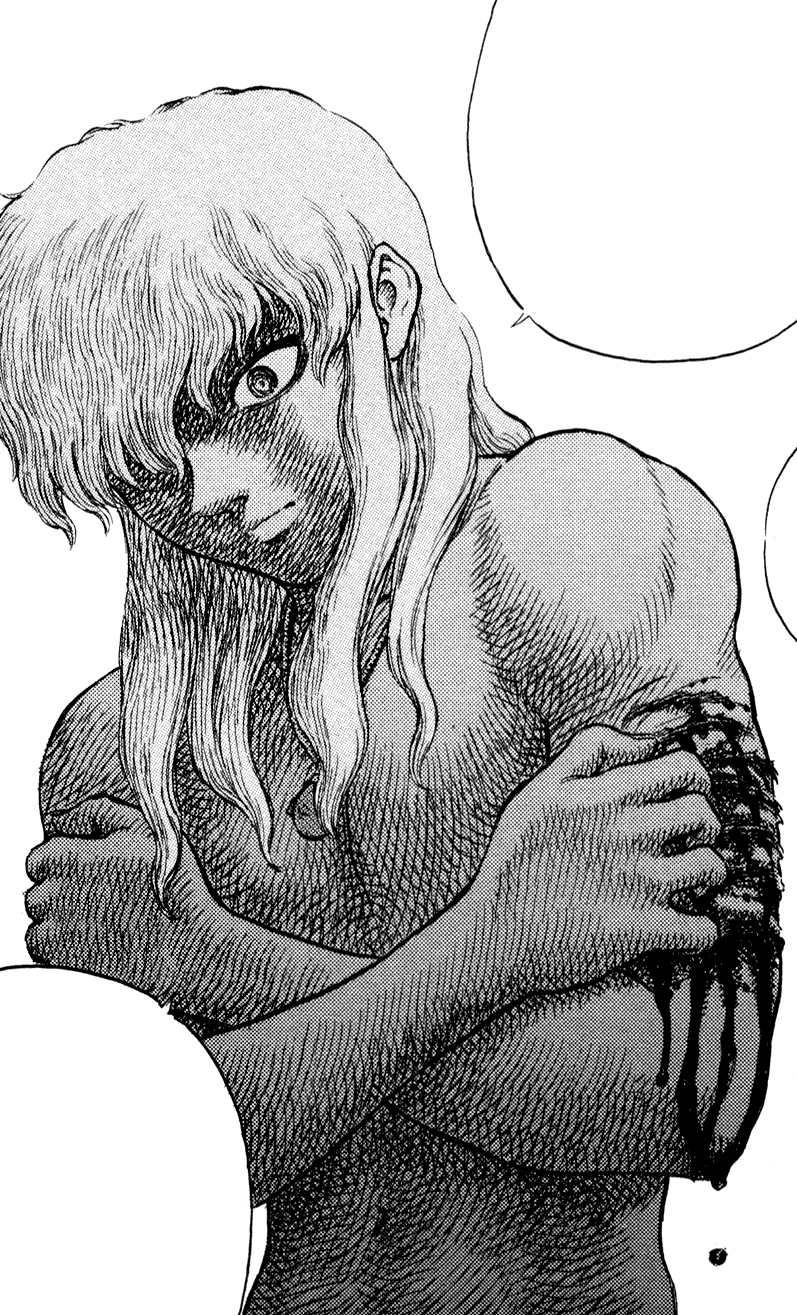 |
| Pictured: human emotion |
While I'm kind of ambivalent of their one-night stand, it was nice for Griffith to have some sort of emotional investment in his advance on Doldrey. He wants to silence Gennon before word of their relationship gets out, Guts wants to prove himself one last time as Griffith's right-hand man, and Casca is more or less seeking revenge on Adon for shaming her in combat. All three of the major players have some sort of investment in the battle, and omitting most of Griffith's relationship with Gennon changes that for the viewer. Of course it's more than hinted at when the two meet on the battlefield, but the manga and 1997 anime are very explicit in what went on between the two of them, how far Griffith would go to bolster the Hawks and how it affected Casca's feelings toward Griffith.
What I can't forgive in this omission is the real reason why Griffith sought Gennon's help in the first place. After discovering a small child who he foolishly allowed on the battlefield in one of the Hawks' first skirmishes, Griffith becomes torn between his dream and the weight of the lives of his men on the battlefield. Griffith is still basically a kid at this point and his dreams are already taking a toll on him. With one small affair between him and Gennon Griffith could bolster his supplies and the lives of his men with only a small personal sacrifice. Casca reveals that learning this caused her to feel complex emotions as well, but the event made her respect Griffith more after learning the emotional turmoil it's caused.

The image of Griffith picking up a wooden toy on top of the corpse of the bright-eyed boy is another one of those major icons of the Golden Age, and without it here not only does it drain the emotional weight of Griffith's choices as leader of the Hawks, it also removes more than a few pivotal gut-punches later in the series. But that's not this review, so we must soldier onward. The film has only been on for seventeen minutes and I'm pretty sure this officially counts as an essay at this point.
Back to the film, Guts and Casca are growing closer for no reason and the famous one-hundred-man battle commences. Adon appears again with his retinue and Guts challenges them all, urging Casca to find Griffith. The animation and choreography is stellar and there's not much to say on it. The 1997 anime is subtitled "A Gale of Blades" or something similar, and this fight represents that idea wonderfully. Guts swings his enormous sword like it's nothing and we get to see a rare occurrence of him struggling, and it's not because he's fighting a giant monster this time.
Casca fights some men on her own, who naturally go straight to rape. She is rescued by the Hawks after fighting off her captors and the focus returns to Guts. After the battle Guts is found by Griffith, Judeau and Casca, the latter of which is suddenly very concerned with his well-being. Casca tearfully hugs him as Griffith approaches. Another funny little addition to the movie is Guts raising his wounded hand, having forgotten that he didn't take the arrow all the way out. I love the small touches the director made--it's a shame so much had to be cut, because a full series with this much attention would be marvelous. The Hawks also capture Adon, a new change to this movie, and one which I naturally hate.
The Battle for Dull-drey
The eponymous battle for Castle Doldrey approaches as some of the Midland army fails at assaulting the castle. Part of the reason the title is unappealing to me is that this is honestly a pretty small part of this mini-arc of the Golden Age, and mostly just serves as padding between the important political maneuvering between the major players. Of course the directors clearly know more about the series than I do, as this battle becomes the forefront of the movie while everything else is pushed aside.
Griffith volunteers to lead the charge into Doldrey, a fortress which has a reputation for its impenetrable nature. Morale and defense are both low and the military council are floundering for a solution, so Griffith states that the Hawks will lead the charge by himself--the King, now convinced of the strength of the Hawks, officially orders the Hawks to attack Doldrey.
I should note that another major scene, the Bonfire of Dreams, was cut from the film. This happens before the council and serves as a relaxing interlude between battles, as Guts is still recovering from the one-hundred-man battle and preparations for the next assault have yet to be finalized. Guts and Casca have a relatively deep conversation about the bonfire in the middle of the Hawks' camp, referring to Griffith as a bonfire himself while the soldiers are akin to the smaller fires around the camp, drawing around a much larger fire. There are great little moments between all the major players in the Hawks, Casca has a cute scene with Griffith, and Guts implies that this will likely be his final campaign with the Hawks. Much like camp scenes in the first film I don't understand why this is cut, because the last thing any of the Berserk films needs is less character development. It's not a particularly protracted scene and serves to ease the viewer into the very real possibility that Guts will be separating himself from the Hawks shortly.

Not only that, but because Griffith's relationship with Gennon is almost cut entirely the transition to the governor of Doldrey is extremely awkward and comes out of nowhere. You've got this old guy being served by effeminate men who look startlingly like Griffith commanding a large armored man, Boscogn, to bring Griffith in alive. There's no context and even the introduction of Boscogn is cut short. Boscogn himself is established as being a frightening Chuder commander after he publicly shames Adon and strips him of command. Because Adon is captured Boscogn can't intimidate him, so rather than having him shown as a leader who commands fear in his underlings he's just shown tearing apart soldiers on the battlefield. I guess that's the only way to make a character intimidating in these dumb movies. Gennon is also strangely older than he was in the original series and manga, so much older in fact that I kind of wonder why he's even lusting for Griffith's loins at all. Shouldn't he be doing old people things like playing Midland Bingo?
Doldrey is more or less Helm's Deep, and part of the reason this battle sticks with me more than the latter is that rather than the heroes being behind the impenetrable fortress, they're strategically rushing to capture the fortress instead. It's a neat concept and one that I think Berserk pulls off well.
A huge, noisy, idiotic CG fight takes place as the Hawks split into two groups. You can only describe action so many ways, but if I had to summarize it I'd have to say "busy" and "ugly." Why is Gennon's harem of little boys aged up? Did they think he was too weird and villainous? Is that why they aged him up? I don't get what's happening with him.
Boscogn and Guts face off, and once again I'm shocked by how poorly the director understands the series. Boscogn kind of serves as the final boss of the Band of the Hawk arc, a mountain of a man who pushes Guts to his limit. In the manga and original series he breaks Guts's massive sword, becoming the first human opponent to push Guts back. He's a stronger opponent than even the hundred troops, and his defeat comes from a surprise assist from Zodd--who is completely absent from this movie.
On the other side of the battlefield, Casca and her troops invade Doldrey while the castle is unoccupied. The soldiers who accompanied Adon back into Doldrey hatch their plan, meaning that Casca had to underhandedly sneak into the fortress in order to win. Adon, somehow, gets his hands on a spear and he and Casca fight. Why did he not just turn around and reveal it was them when they were going through Boscogn's vanguard? Why did he wait until after they took over the castle before launching a last-ditch attack? He was surrounded by Hawks, what could he have possibly expected? This movie is so stupid.
Adon breaks Casca's sword and she kills him by stealing his sword, which they should have confiscated, and pirouettes around his spear to stab him in the throat. A much less impressive finish than her flipping over him and cutting his head in half, but "much less impressive" is more or less this film's tagline. On the other side of the battlefield Guts somehow distracts Boscogn, a military general, with a flag, sneaks around him, and cuts off his and his horse's head in one swing. Again, more impressive in the original when it was a desperate swing of a sword Zodd threw to him after Guts was pushed back by Boscogn. At this point Guts has had absolutely zero challenge and nobody has been able to defeat him in battle. This gives the impression that Guts is unbeatable when, by this point in the two original series, he's been pushed to his limit enough times that the viewer can appreciate a villain when they've got the upper hand, while still cheering when Guts effortlessly takes out mobs of goons. He's not supposed to be unbeatable, just extremely tough.
After suffering defeat through under-handed and virtually impossible means, Gennon is left alone on the battlefield as Griffith approaches him (at about three frames per second). The conversation they had in the original versions plays out almost verbatim, which has no emotional weight because it's a payoff to what should be a fairly long-running story arc. The lighting looks very good here though. At least there's some positive aspect here, but compared to how flaccid this scene feels wihout the emotional weight it doesn't mean much. The Hawks then go on to murder Gennon's innocent booty boys for seemingly no reason.
It's like Michael Bay directed this movie: all substance with the life and soul vampired out of it. The reason Berserk resonates with so many people is that these massive onslaughts and incredible battles are predicated upon with heavy emotional investment. Griffith had an affair with Gennon because of the traumatic weight of the child soldier's death, allowing him enough supplies to maintain his men and avoid unnecessary casualties. Guts holding Casca is sincere because we've seen how he reacts to people simply brushing against him. Having empathy for these characters comes naturally because they have traumatic life experiences, which is why we love watching them succeed and hate to see them fail. Berserk creator and famed iDOLM@STER connoisseur Kentaro Miura answered an interview question saying that Berserk has more in common with shoujo (teen girl) manga than a series aimed at men, as girl-oriented characters "express every feeling powerfully." It elevates the massive action setpieces to resonate more powerfully with viewers. If anything, these movies are like the shonen or male-oriented series that people might consider it at first glance. The emotions are sucked out of these movies and it shows. Well, and about half the story content as well. Speaking of story, let's get back into this thing.
53 minutes into the film, the reviewer reflects on his decisions and feels for the first time regret at the failure of his life
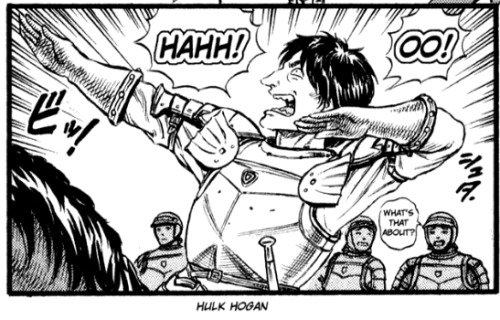
The Hawks return with great fanfare to Windham, capital city of Midland. We don't get to see Charlotte fussing about to see Griffith, we don't get to see Corkus Hulk Out--although he does pick up a woman like a puppy. It's pretty off-putting and again, all the soul is ripped completely out of the scene.
More cuts are made to the story, although one--which I mentioned earlier--had me so bummed that it ruined the rest of the experience. In the original versions, Foss and the Queen have nearly finished their scheme to take Griffith out of the picture. This is also when the Queen mourns for Julius, who she's having an affair with. Because Foss was excised entirely the subplot with his daughter is removed, wherein Griffith kidnaps an innocent little girl and holds her hostage to get information out of Foss. The darkest depths of Griffith's ambition begins to be explored, and the characters in general are much deeper than they are in this film. Griffith rises up as a famous general with no opposition and it feels lazy.
Next is the ballroom scene, a fun diversion from the action as the characters relax and enjoy themselves among the nobles. The only people who aren't having fun, as it were, are Guts and Casca, who connect more deeply than they did in the forest. For whatever reason the Conviction Arc characters Farnese, Serpico and Azan are here, totally out of place for where they should be in the story. Yeah, cameos are alright I guess, but what are they doing here? Wouldn't the Vandimions specifically be trying to stay out of the Midland-Chuder conflict? Why would they show up this quickly? As far as I can remember this trio should be at the Holy See, investigating the coming of the Hawk of Darkness. What's going on here, exactly? Shouldn't Farnese and Serpico be too young at this point? This cameo is terrible.
In the original story, this is the point when the Queen lays her trap. Griffith drinks poisoned wine, interrupting the ball and creating pandemonium. Guts chases down the assassin, but the real event takes place hours later: Foss traps the Queen's council with the rest of the conspirators and Griffith has them burned alive. Griffith casually explains that there are no innocent players in war, and that she's lost her game. The Queen dies shouting Griffith's name, and Foss is reunited with his daughter. Guts, again, kills the mercenaries Griffith hired, this time as one final favor to Griffith and the Hawks. There is now nobody to get in Griffith's way and Foss, now terrified, is wrapped around Griffith's finger for any future plan he has in mind. In short, Griffith has succeeded.
None of this happens in the film. Not one bit. Not a single ounce of this story thread is explored, and instead of political intrigue the viewer is damned to watch ugly CG models dancing around in the ball room. NOTHING happens and the entire point of the ballroom scene is completely ruined. The King also allows Charlotte to meet with Griffith, which contradicts a later point in the film. This alone makes the movie a hideous failure in my eyes, far worse than anything in the previous film. But don't worry, it's not over yet!
Time for more removed scenes! After tying up his loose ends, Guts decides once and for all to quit the Band of the Hawk. Before he can go, Casca stops him to plead for Guts to stay. After he leaves her behind, Judeau and Corkus take him to a bar and try to reason with him; while Corkus angrily refutes Guts's desires to separate himself and follow his own dreams, while Judeau gives a little bit of his backstory and actually encourages Guts to set off on his own. In particular, Judeau hints that Guts should ask Casca to come along with him on his journey, if not at least tell her how he feels. Guts explains he can't do that because it would mean separating Casca from her own dream of following Griffith. More character development which is sadly cut, and instead the scene just shifts completely to Guts leaving the Hawks.
For no reason, the important members of the Hawks--Casca, Corkus, Judeau, Pippin, Rickert and Griffith all appear on a hill outside of Windham and deliver what amounts to an extremely truncated version of their original lines. Griffith is stunned that Guts would leave, and I'm stunned because the characters all guessed that Guts would leave on the same night of the ball and take this exact path. Corkus just comes off as a jerk rather than a weak coward who depends on Griffith, Judeau has nothing to say, Pippin says nothing and Casca makes a half-hearted attempt to keep him from leaving. The only reason they cut him off in the original is because Casca noticed Guts leaving and had time to call Griffith to run in front of him while Judeau and Corkus distracted him. It makes absolutely no sense that they'd meet Guts on the hill and I'm still stunned that the director thought this was a good idea.
In case all these omissions have been confusing, allow me to recap events comparing the source material to the second film. The red highlights are used to emphasize cut plot points which serve as build-up for this film and the next.
Charlotte gives Griffith her lodestone - Casca falls off the cliff - Casca tells Guts her backstory and Griffith's affair with Gennon - the One-Hundred Man battle - Bonfire of Dreams - the council of war - Battle for Doldrey - the ball - Foss's betrayal and the queen's death - Guts is confronted by Casca, Judeau and Corkus - Guts arrives on the hill
Casca falls off the cliff - Casca's backstory plays to the audience - the One Hundred Man battle - the council of war - the Battle for Doldrey - the ball - Guts arrives on the hill
The movie is called The Battle for Doldrey, yet this event in the manga is surrounded by heavy emotional scenes and punctuated by Griffith eliminating his political opponents. The Midland-Chuder conflict is just another battle for the Hawks, though one which catapults them into fame and glory. Up to this point in the film, almost nothing of substance has actually occurred outside of the major battle scenes--some of which, namely the eponymous battle for Doldrey, have been heavily simplified. As noted, all of the content cut from the film is character development but every single bit of it is used as setup for either later events in the second film or parts of the next film.
Either way, Guts and Griffith have their rematch, and even a one-swing battle lacks the impact of the original. A big reason for this being that Griffith begins to calculate how he can win against Guts. While it probably wouldn't have played out well in a feature film, it's important that Griffith doesn't once believe he can lose this fight. In the moments before they clash, Griffith goes over several tactics on how best to swing his blade so as not to disfigure or kill Guts.
So when he ultimately loses his duel, has his shoulder bruised and his blade snapped, it's more than just a demoralizing loss--Griffith's entire world is shattered because he never once considered he'd lose the duel. While there is a small amount of inner monologue of Griffith asking himself why Guts would want to quit, it means very little when the viewer is not given the simple tidbit of why Griffith becomes so broken from this loss. Guts has not only overpowered him physically, but mentally as well. He's broken past Griffith's ambition and none of the Hawk can stop him from leaving now, not that they would want to. There's no reason for this small detail to be cut out when the director was already so good about adding little touches to some scenes.
That said, the impact of their duel is pretty impressive, short and sweet but animated with great precision and care. It lacks much of the emotional weight, but at least it looks good. Having Guts casually exhale is a nice little touch and shows just how little effort Guts put into their duel. After fighting the likes of Boscogn, it's no doubt that Guts thought Griffith was small potatoes.
The Payoff
The payoff for all these loose ends and removed scenes hits home in the film's ending scenes. Griffith shows up to Charlotte's room during a storm that night, and without wasting any time things are wrong. In the original, Charlotte is distraught after the death of her stepmother--which she doesn't know is Griffith's fault--and basically allows Griffith to seduce her. The events leading to this payoff make every little detail seem like they were put into place very meticulously--and if you've read the deleted scene from the manga, you know exactly why that is.
Charlotte, a young woman whose life is torn between her duty as princess and her yearning for Griffith, is emotionally fragile after the death of her stepmother--who her father married because her birth mother also died. Charlotte is a character surrounded by tragedy who just keeps making bad mistakes to get away from her tragic upbringing; a girl who would rather live a simple life than that of a noble. And here comes Griffith, swoocing right in to take the pain away. And Griffith himself is emotionally devastated after losing his one true love, big hulking manly Guts. So the two do what is definitely a bad idea and give into Griffith's seduction; Griffith is having revenge sex on Guts with the woman he's been courting, while Charlotte is embracing the man she loves while he's in pain.
Nope!
Because the film has cut so much--the assassination of the queen, manipulating Foss, Griffith having "bro" moments with Guts after killing the hired thugs, the revelation of Griffith's loss of innocence with the child soldier, and a host of other omitted details--this emotional roller coaster of a sex scene is completely sapped of its intended goal as the payoff for Griffith's ambition. Griffith has surrounded himself with strong individuals both as allies and enemies, and after seeing the depths of his ambition it's crushing to see that he's still just a man and is prone to weakness like everybody else.
In Battle for Doldrey, Griffith going to Charlotte just makes him look like a big whiny baby. There's no stress that's gotten under his skin, there's no evil undercurrent that's been peaking through the whole time. The sex scene instead just comes off as a petulant child who had one thing go wrong and he's throwing a fit. This isn't a man who's been poisoned in public, who's been forced to kidnap a child and even assassinate a queen just to survive.
It should also be noted that in the prologue of both the manga and original anime, Guts is wandering the land as the black swordsman while hunting Griffith and the apostles for revenge. Part of why this works so well is that moments like this imply that Guts merely walking out on the Hawks caused Griffith to snap, and why his subsequent capture is all the more confusing as complications arise. The viewer might think Griffith became king and persecuted Guts after seducing Charlotte, and after his capture the viewer is left to realize that something very dark happened to turn the crippled Griffith into the godlike Femto. I should also point out that Charlotte reacts way too strongly to a simple titty-grab. Come on dude, it's not that big a deal.
Like the ballroom dance and the enormous and ugly battle scene, far too much of the budget was put into this scene. Yeah, it's hot and sweaty and Griffith thinking about Guts while pounding a babe is as creepy as it needs to be for his character, but this scene didn't need to be two minutes long while the assassination and child soldier subplots were omitted. Then when Griffith climaxes he does so in like a cross position so that it looks like he's Jesus. It's strange, unnecessary, and honestly feels indulgent. Not that I'm saying it didn't need to be in the movie, it's a pivotal part of Griffith's character, but when so much was cut at its expense I just can't help but wonder how much of the budget had to be diverted to each individual hump.
The morning after, Griffith is caught immediately without putting up a fight. Another important detail was cut so that we could see a close-up of Charlotte's fat butt: Griffith doesn't go for his sword. It's a minor detail, but in the original he doesn't have his sword because Guts broke it, and if he'd had it he might have been able to escape the Windham guards. But he doesn't even twitch his sword hand. Griffith doesn't try in the least. What a hero.
Meanwhile, the Hawks are summoned for "training" and are ruthlessly massacred by the Midland Army. Luckily, arrows only rain down on red shirts as far as the viewer can tell. Griffith is being tortured by the King, who condemns Griffith and tells him that his dream is over. Griffith chides the king for being horned up for his own daughter and that his refusal to sign a political marriage in wartime was suspicious, so the king nearly whips him to death.
Casca leads the Hawks away from the field as the King orders a deformed torturer to keep Griffith alive, telling him to ensure the Hawk never takes flight again. In another part of the country, Guts crosses paths with a caravan carrying a certain elf, and Guts stops for just a second to look back. In the torture chamber, the torturer grabs Griffith's Red Behelit, the Egg of the King, and drops it into the sewer.
Finally, one final scene that's missing: the King actually goes up to Charlotte's chambers and very much attempts to rape her. Griffith was not wrong in his assumption, and when a horrified Charlotte literally kicks the King's teeth in it naturally destroys their already-strained relationship. It's a terrifying addition to an already unsettling story, and once again the omission of this plot detail completely shatters important events in a later story arc.
Verdict
Loud, overly-indulgent, ugly and skipping key scenes that are necessary for character arcs and simple motivation, Berserk: The Battle for Doldrey is doubtlessly the absolute worst way to experience the story of the Golden Age. Key characters who need to be present for the story are entirely absent, fight choreography is uninspired and some battles have their stakes all but thrown away, and honestly I don't think I need to elaborate further. A pitiful attempt at adapting one of my favorite manga series of all time, Battle for Doldrey indulges in its ugly CG battles rather than focus on the heart and soul of what made Berserk such an unforgettable ride. I spent most of this review just pointing out inconsistencies and removed plot elements, and that alone should indicate the correct answer is simply...
READ THE MANGA.