Tuesday, September 27, 2016

Review and Analysis: Berserk - The Battle for Doldrey

Eons ago, we took a look at the first of the Berserk reboot films, The Egg of the King. While I'm not particularly in love with the film and think it's a failure on many levels, it's at least a competent movie considering its budget and run time. They fit as much as they could in there, although I'd argue they could have pared back on the giant, ugly battle scenes littering the film. It might be a bad entry to Berserk, but for someone with no interest in the manga or original anime it's better than nothing at all.

That criticism doesn't apply to The Battle for Doldrey, the second film in the reboot trilogy. Bigger, flashier, uglier, and missing all the subtlety of Berserk, this film instead capitalizes on the notion that we really just need to get to the third film already so let's get through this as quickly as possible. What ensues might be the biggest regretful purchase of my entire life, a sequel that doubles down on all the faults of the original while cramming as much worthless CG as possible. Let's get down to business--someone's gotta put effort into this movie, right?

Big Dumb Action

As I mentioned, one of the biggest flaws of the first Golden Age film is the near-total excision of many of the tragic scenes which give Berserk its emotional weight. When going into this movie my initial thought was "it cannot be as bad as the first." Some of the most iconic Berserk moments occur during the events of the film, and a fan of the series only needs to hear that the film adapts the Golden Age chapters starting with the Hawks' assault on the fortress Doldrey and eventually ending on Griffith's fall from grace to get excited for the political intrigue to come. These chapters are actually my favorite part of the Golden Age as we not only get to see the inner machinations of the politics in the setting, but we also get very interesting battle scenes as well as many character arcs being fleshed out--both the Band of the Hawk and the political leaders of Midland and Chuder are explored in-depth. Basically, Battle for Doldrey is the cornerstone of the Golden Age; without this span of chapters the emotional punch of the Golden Age finale is severely lessened.

After the credits, Battle for Doldrey wastes no time in disappointing the viewer. Rather than the intricate political scheming between the queen of Midland, Foss and Griffith, the movie rushes straight into the first major battle of Doldrey with Griffith's Raiders leading the Hawk into battle. Foss was removed from Julius's schemes in the first film and I was hoping that at least he'd make an appearance starting from this point, and his exclusion from this film means that several of the most important emotional anchors holding down the Golden Age story arc have been entirely lifted. As a reader of the manga or even someone who has viewed the 1997 anime, this is likely going to be the film loses much of its weight. Foss becomes a major player later in this point of the story, the Queen of Midland is important for Griffith's development, and the loss of her initial encounter with Griffith means that he no longer has any political strife in the story.

Arguably Griffith's most terrifying display of strength is completely absent from this film.

I want to talk about the Queen a little more before I move on to this abortion of a film. The Queen, who as far as I can tell is never properly named in the story, serves as both a raising of stakes in Griffith's meteoric rise in political power and a means of exploring the consequences of Guts assassinating Julius. The Queen and Julius were having an affair and she's positive Griffith was responsible for his death, so not only is Guts wracked with the emotional guilt of murdering Julius and Adonis but now Griffith himself is brought back into the tumultuous plot. Her death also serves as a grim reminder that Griffith is far from the pure, angelic figure he portrays for the masses. I'll go into that in more detail later in the review, but Griffith's character is explored very well at this point in the story and without the Queen's presence much of that character development is removed.

Even more startling than this omission is the removal of Charlotte and Griffith's courting. Before leaving Midland Charlotte gives Griffith a small magnet in the shape of a knight; she tells him it's good luck and that her similar magnet will be drawn to his when he returns from battle. It's a naive and rather cute moment from a character who is basically just drawn in to Griffith's political schemes without much say in the matter, and this small gesture is a small nod to the audience that Griffith has won her heart over after his attempts in the previous film. It may not seem like much, but it gives depth to their relationship which makes later events in the film utterly baffling without their inclusion.  And just remember, these three paragraphs come from seconds of starting the film. Get ready, we've only just begun.

"The aptly-named Sir-Not-Appearing-In-This-Film"
As the film opens, Guts is tearing through Chuder troops while mulling over Griffith's shattering words at the end of the previous film. While this gaudy CG battle is a rather annoying and busy way to begin the movie, it's actually a relief to see that the CG budget has clearly been improved and it may not be such an eyesore this time around.

Casca is having problems of her own as her period is starting on the battlefield and gets into a scrap with the chauvinist Adon, a comic relief villain who loves shouting his attacks out as if this were an anime or something. Adon effortlessly wipes out some Hawk redshirts and taunts Casca before Guts appears to drive him back. Casca cuts the fight short after passing out off a cliff; Adon shoots Guts with a crossbow before he can pull her up and the two tumble into a nearby river. Before I continue I want to remark on just how impressive the visuals are for this movie, especially at this point in the pouring rain as Guts and Casca are drenched after the brutal dive from the cliff. We're not talking about this from a visual standpoint and I don't want to harp on about such a small aspect, so I just wanted to get it out of the way here.

Griffith hears a report that Casca and Guts have gone missing and a soldier warns Griffith to not cut their forces before the scene goes back to Casca and Guts in a cave. There's a cute little moment where a bug crawls on Casca's head and Guts delicately sets it aside, a detail that's new in this film, and casually strips off her soaked clothes. He realizes she's on her period and remarks on how difficult it must be to be a woman. The camera pans out on one of Berserk's most iconic moments: Guts, taciturn with one hand on his sword and another around a nude Casca, watching diligently for soldiers as he repays Casca for doing the same when he first met the Hawks.


I love this scene and it's honestly one of the first that comes to mind when I think about the Golden Age, and it's done more or less with the respect its due here. My only problem stems not from the cinematography itself but rather how Guts is portrayed in general in the film. Guts is still a teenager at this point in the story, still insecure and very young. This is the most intimate he's ever been with a person, and the image of him doing this as a teenager while still traumatized by Donavon makes him look more mature than his age. In the film, Guts just looks like normal Guts. Huge, intimidating, square-jawed and built like a brick wall. The innocence of youth is all but gone because he looks like he's in his thirties. What should be a tender moment between youth is less impactful.

Emotional Roller Coasters

Moving on, another out-of-focus moronic flashback is shown. Casca is beaten and nearly raped by a nobleman before Griffith rescues her, leaving her with his sword to test her resolve. She murders the nobleman and the flashback ends. Casca wakes up and is less than pleased with Guts in a humorous exchange as she throws pieces of armor and even her sword at Guts. The humor is drained when Guts callously brings up her position as a woman, which causes her to break down and spill her

guts

about why she hates him.

In a shocking display of ineptitude the film skips Casca explaining her past to Guts. I don't know why they couldn't have put the flashback here when she's explaining why she's jealous of Guts. This is the big moment when they finally start to understand each other, when Casca explains how she came from a poor village and a nobleman saved her only to reveal he wanted her for his rape dungeon (or whatever) and Griffith rescued her. Even more perplexing is the omission of a large majority of Griffith's tryst with Gennon, governor of Castle Doldrey. There are a few throwaway lines that tell the audience about this event, but compared to the original version where it's shown just how involved the two were it's pretty disappointing.
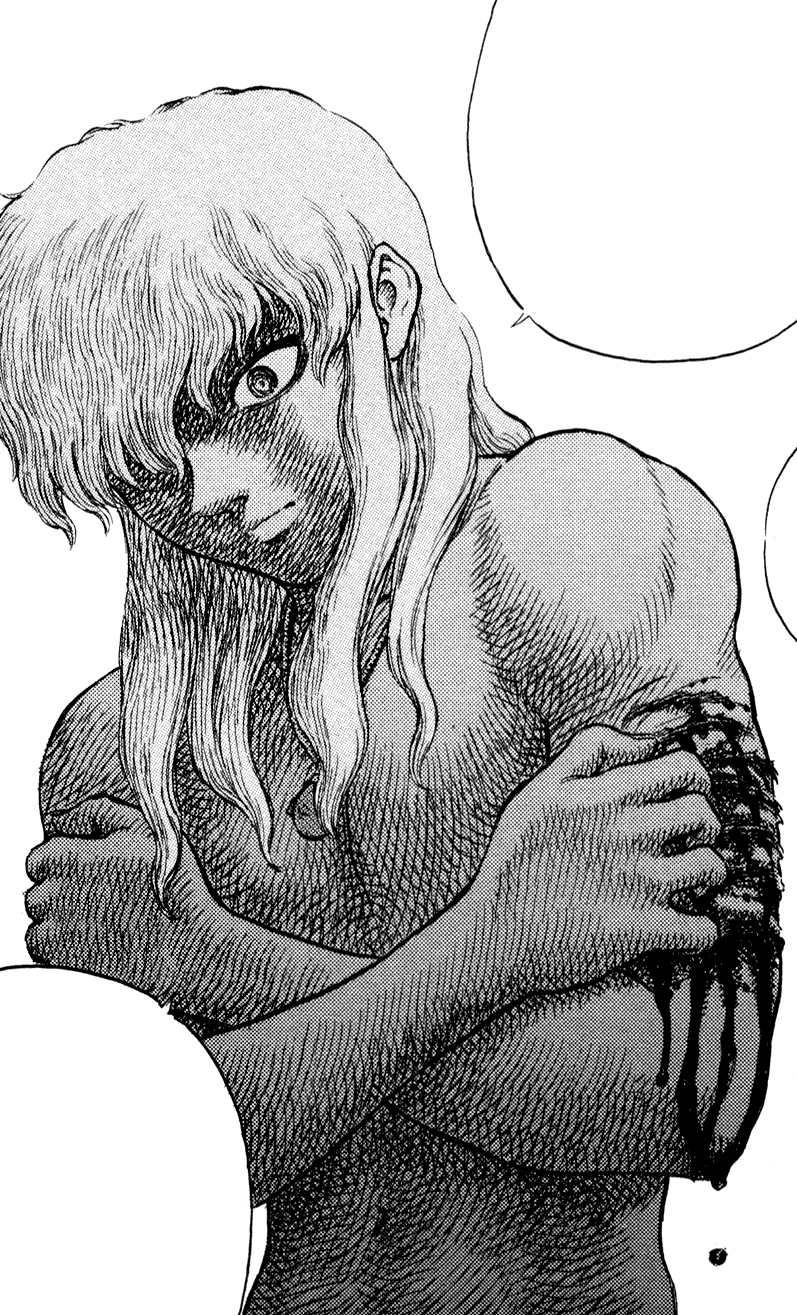
Pictured: human emotion

While I'm kind of ambivalent of their one-night stand, it was nice for Griffith to have some sort of emotional investment in his advance on Doldrey. He wants to silence Gennon before word of their relationship gets out, Guts wants to prove himself one last time as Griffith's right-hand man, and Casca is more or less seeking revenge on Adon for shaming her in combat. All three of the major players have some sort of investment in the battle, and omitting most of Griffith's relationship with Gennon changes that for the viewer. Of course it's more than hinted at when the two meet on the battlefield, but the manga and 1997 anime are very explicit in what went on between the two of them, how far Griffith would go to bolster the Hawks and how it affected Casca's feelings toward Griffith.

What I can't forgive in this omission is the real reason why Griffith sought Gennon's help in the first place. After discovering a small child who he foolishly allowed on the battlefield in one of the Hawks' first skirmishes, Griffith becomes torn between his dream and the weight of the lives of his men on the battlefield. Griffith is still basically a kid at this point and his dreams are already taking a toll on him. With one small affair between him and Gennon Griffith could bolster his supplies and the lives of his men with only a small personal sacrifice. Casca reveals that learning this caused her to feel complex emotions as well, but the event made her respect Griffith more after learning the emotional turmoil it's caused.


The image of Griffith picking up a wooden toy on top of the corpse of the bright-eyed boy is another one of those major icons of the Golden Age, and without it here not only does it drain the emotional weight of Griffith's choices as leader of the Hawks, it also removes more than a few pivotal gut-punches later in the series. But that's not this review, so we must soldier onward. The film has only been on for seventeen minutes and I'm pretty sure this officially counts as an essay at this point.

Back to the film, Guts and Casca are growing closer for no reason and the famous one-hundred-man battle commences. Adon appears again with his retinue and Guts challenges them all, urging Casca to find Griffith. The animation and choreography is stellar and there's not much to say on it. The 1997 anime is subtitled "A Gale of Blades" or something similar, and this fight represents that idea wonderfully. Guts swings his enormous sword like it's nothing and we get to see a rare occurrence of him struggling, and it's not because he's fighting a giant monster this time.

Casca fights some men on her own, who naturally go straight to rape. She is rescued by the Hawks after fighting off her captors and the focus returns to Guts. After the battle Guts is found by Griffith, Judeau and Casca, the latter of which is suddenly very concerned with his well-being. Casca tearfully hugs him as Griffith approaches. Another funny little addition to the movie is Guts raising his wounded hand, having forgotten that he didn't take the arrow all the way out. I love the small touches the director made--it's a shame so much had to be cut, because a full series with this much attention would be marvelous. The Hawks also capture Adon, a new change to this movie, and one which I naturally hate.

The Battle for Dull-drey

The eponymous battle for Castle Doldrey approaches as some of the Midland army fails at assaulting the castle. Part of the reason the title is unappealing to me is that this is honestly a pretty small part of this mini-arc of the Golden Age, and mostly just serves as padding between the important political maneuvering between the major players. Of course the directors clearly know more about the series than I do, as this battle becomes the forefront of the movie while everything else is pushed aside.

Griffith volunteers to lead the charge into Doldrey, a fortress which has a reputation for its impenetrable nature. Morale and defense are both low and the military council are floundering for a solution, so Griffith states that the Hawks will lead the charge by himself--the King, now convinced of the strength of the Hawks, officially orders the Hawks to attack Doldrey.

I should note that another major scene, the Bonfire of Dreams, was cut from the film. This happens before the council and serves as a relaxing interlude between battles, as Guts is still recovering from the one-hundred-man battle and preparations for the next assault have yet to be finalized. Guts and Casca have a relatively deep conversation about the bonfire in the middle of the Hawks' camp, referring to Griffith as a bonfire himself while the soldiers are akin to the smaller fires around the camp, drawing around a much larger fire. There are great little moments between all the major players in the Hawks, Casca has a cute scene with Griffith, and Guts implies that this will likely be his final campaign with the Hawks. Much like camp scenes in the first film I don't understand why this is cut, because the last thing any of the Berserk films needs is less character development. It's not a particularly protracted scene and serves to ease the viewer into the very real possibility that Guts will be separating himself from the Hawks shortly.


Not only that, but because Griffith's relationship with Gennon is almost cut entirely the transition to the governor of Doldrey is extremely awkward and comes out of nowhere. You've got this old guy being served by effeminate men who look startlingly like Griffith commanding a large armored man, Boscogn, to bring Griffith in alive. There's no context and even the introduction of Boscogn is cut short. Boscogn himself is established as being a frightening Chuder commander after he publicly shames Adon and strips him of command. Because Adon is captured Boscogn can't intimidate him, so rather than having him shown as a leader who commands fear in his underlings he's just shown tearing apart soldiers on the battlefield. I guess that's the only way to make a character intimidating in these dumb movies. Gennon is also strangely older than he was in the original series and manga, so much older in fact that I kind of wonder why he's even lusting for Griffith's loins at all. Shouldn't he be doing old people things like playing Midland Bingo?

Doldrey is more or less Helm's Deep, and part of the reason this battle sticks with me more than the latter is that rather than the heroes being behind the impenetrable fortress, they're strategically rushing to capture the fortress instead. It's a neat concept and one that I think Berserk pulls off well.

A huge, noisy, idiotic CG fight takes place as the Hawks split into two groups. You can only describe action so many ways, but if I had to summarize it I'd have to say "busy" and "ugly." Why is Gennon's harem of little boys aged up? Did they think he was too weird and villainous? Is that why they aged him up? I don't get what's happening with him.

Boscogn and Guts face off, and once again I'm shocked by how poorly the director understands the series. Boscogn kind of serves as the final boss of the Band of the Hawk arc, a mountain of a man who pushes Guts to his limit. In the manga and original series he breaks Guts's massive sword, becoming the first human opponent to push Guts back. He's a stronger opponent than even the hundred troops, and his defeat comes from a surprise assist from Zodd--who is completely absent from this movie.

On the other side of the battlefield, Casca and her troops invade Doldrey while the castle is unoccupied. The soldiers who accompanied Adon back into Doldrey hatch their plan, meaning that Casca had to underhandedly sneak into the fortress in order to win. Adon, somehow, gets his hands on a spear and he and Casca fight. Why did he not just turn around and reveal it was them when they were going through Boscogn's vanguard? Why did he wait until after they took over the castle before launching a last-ditch attack? He was surrounded by Hawks, what could he have possibly expected? This movie is so stupid.

Adon breaks Casca's sword and she kills him by stealing his sword, which they should have confiscated, and pirouettes around his spear to stab him in the throat. A much less impressive finish than her flipping over him and cutting his head in half, but "much less impressive" is more or less this film's tagline. On the other side of the battlefield Guts somehow distracts Boscogn, a military general, with a flag, sneaks around him, and cuts off his and his horse's head in one swing. Again, more impressive in the original when it was a desperate swing of a sword Zodd threw to him after Guts was pushed back by Boscogn. At this point Guts has had absolutely zero challenge and nobody has been able to defeat him in battle. This gives the impression that Guts is unbeatable when, by this point in the two original series, he's been pushed to his limit enough times that the viewer can appreciate a villain when they've got the upper hand, while still cheering when Guts effortlessly takes out mobs of goons. He's not supposed to be unbeatable, just extremely tough.

After suffering defeat through under-handed and virtually impossible means, Gennon is left alone on the battlefield as Griffith approaches him (at about three frames per second). The conversation they had in the original versions plays out almost verbatim, which has no emotional weight because it's a payoff to what should be a fairly long-running story arc. The lighting looks very good here though. At least there's some positive aspect here, but compared to how flaccid this scene feels wihout the emotional weight it doesn't mean much. The Hawks then go on to murder Gennon's innocent booty boys for seemingly no reason.

It's like Michael Bay directed this movie: all substance with the life and soul vampired out of it. The reason Berserk  resonates with so many people is that these massive onslaughts and incredible battles are predicated upon with heavy emotional investment. Griffith had an affair with Gennon because of the traumatic weight of the child soldier's death, allowing him enough supplies to maintain his men and avoid unnecessary casualties. Guts holding Casca is sincere because we've seen how he reacts to people simply brushing against him. Having empathy for these characters comes naturally because they have traumatic life experiences, which is why we love watching them succeed and hate to see them fail. Berserk creator and famed iDOLM@STER connoisseur Kentaro Miura answered an interview question saying that Berserk has more in common with shoujo (teen girl) manga than a series aimed at men, as girl-oriented characters "express every feeling powerfully." It elevates the massive action setpieces to resonate more powerfully with viewers. If anything, these movies are like the shonen or male-oriented series that people might consider it at first glance. The emotions are sucked out of these movies and it shows. Well, and about half the story content as well. Speaking of story, let's get back into this thing.

53 minutes into the film, the reviewer reflects on his decisions and feels for the first time regret at the failure of his life

The Hawks return with great fanfare to Windham, capital city of Midland. We don't get to see Charlotte fussing about to see Griffith, we don't get to see Corkus Hulk Out--although he does pick up a woman like a puppy. It's pretty off-putting and again, all the soul is ripped completely out of the scene.
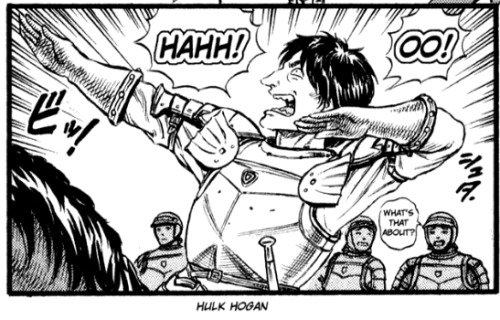


More cuts are made to the story, although one--which I mentioned earlier--had me so bummed that it ruined the rest of the experience. In the original versions, Foss and the Queen have nearly finished their scheme to take Griffith out of the picture. This is also when the Queen mourns for Julius, who she's having an affair with. Because Foss was excised entirely the subplot with his daughter is removed, wherein Griffith kidnaps an innocent little girl and holds her hostage to get information out of Foss. The darkest depths of Griffith's ambition begins to be explored, and the characters in general are much deeper than they are in this film. Griffith rises up as a famous general with no opposition and it feels lazy.

Next is the ballroom scene, a fun diversion from the action as the characters relax and enjoy themselves among the nobles. The only people who aren't having fun, as it were, are Guts and Casca, who connect more deeply than they did in the forest. For whatever reason the Conviction Arc characters Farnese, Serpico and Azan are here, totally out of place for where they should be in the story. Yeah, cameos are alright I guess, but what are they doing here? Wouldn't the Vandimions specifically be trying to stay out of the Midland-Chuder conflict? Why would they show up this quickly? As far as I can remember this trio should be at the Holy See, investigating the coming of the Hawk of Darkness. What's going on here, exactly? Shouldn't Farnese and Serpico be too young at this point? This cameo is terrible.

In the original story, this is the point when the Queen lays her trap. Griffith drinks poisoned wine, interrupting the ball and creating pandemonium. Guts chases down the assassin, but the real event takes place hours later: Foss traps the Queen's council with the rest of the conspirators and Griffith has them burned alive. Griffith casually explains that there are no innocent players in war, and that she's lost her game. The Queen dies shouting Griffith's name, and Foss is reunited with his daughter. Guts, again, kills the mercenaries Griffith hired, this time as one final favor to Griffith and the Hawks. There is now nobody to get in Griffith's way and Foss, now terrified, is wrapped around Griffith's finger for any future plan he has in mind. In short, Griffith has succeeded.

None of this happens in the film. Not one bit. Not a single ounce of this story thread is explored, and instead of political intrigue the viewer is damned to watch ugly CG models dancing around in the ball room. NOTHING happens and the entire point of the ballroom scene is completely ruined. The King also allows Charlotte to meet with Griffith, which contradicts a later point in the film. This alone makes the movie a hideous failure in my eyes, far worse than anything in the previous film. But don't worry, it's not over yet!

Time for more removed scenes! After tying up his loose ends, Guts decides once and for all to quit the Band of the Hawk. Before he can go, Casca stops him to plead for Guts to stay. After he leaves her behind, Judeau and Corkus take him to a bar and try to reason with him; while Corkus angrily refutes Guts's desires to separate himself and follow his own dreams, while Judeau gives a little bit of his backstory and actually encourages Guts to set off on his own. In particular, Judeau hints that Guts should ask Casca to come along with him on his journey, if not at least tell her how he feels. Guts explains he can't do that because it would mean separating Casca from her own dream of following Griffith. More character development which is sadly cut, and instead the scene just shifts completely to Guts leaving the Hawks.

For no reason, the important members of the Hawks--Casca, Corkus, Judeau, Pippin, Rickert and Griffith all appear on a hill outside of Windham and deliver what amounts to an extremely truncated version of their original lines. Griffith is stunned that Guts would leave, and I'm stunned because the characters all guessed that Guts would leave on the same night of the ball and take this exact path. Corkus just comes off as a jerk rather than a weak coward who depends on Griffith, Judeau has nothing to say, Pippin says nothing and Casca makes a half-hearted attempt to keep him from leaving. The only reason they cut him off in the original is because Casca noticed Guts leaving and had time to call Griffith to run in front of him while Judeau and Corkus distracted him. It makes absolutely no sense that they'd meet Guts on the hill and I'm still stunned that the director thought this was a good idea.

In case all these omissions have been confusing, allow me to recap events comparing the source material to the second film. The red highlights are used to emphasize cut plot points which serve as build-up for this film and the next.

Charlotte gives Griffith her lodestone - Casca falls off the cliff - Casca tells Guts her backstory and Griffith's affair with Gennon - the One-Hundred Man battle - Bonfire of Dreams - the council of war - Battle for Doldrey - the ball - Foss's betrayal and the queen's death - Guts is confronted by Casca, Judeau and Corkus - Guts arrives on the hill

Casca falls off the cliff - Casca's backstory plays to the audience - the One Hundred Man battle - the council of war - the Battle for Doldrey - the ball - Guts arrives on the hill

The movie is called The Battle for Doldrey, yet this event in the manga is surrounded by heavy emotional scenes and punctuated by Griffith eliminating his political opponents. The Midland-Chuder conflict is just another battle for the Hawks, though one which catapults them into fame and glory. Up to this point in the film, almost nothing of substance has actually occurred outside of the major battle scenes--some of which, namely the eponymous battle for Doldrey, have been heavily simplified. As noted, all of the content cut from the film is character development but every single bit of it is used as setup for either later events in the second film or parts of the next film.

Either way, Guts and Griffith have their rematch, and even a one-swing battle lacks the impact of the original. A big reason for this being that Griffith begins to calculate how he can win against Guts. While it probably wouldn't have played out well in a feature film, it's important that Griffith doesn't once believe he can lose this fight. In the moments before they clash, Griffith goes over several tactics on how best to swing his blade so as not to disfigure or kill Guts.

So when he ultimately loses his duel, has his shoulder bruised and his blade snapped, it's more than just a demoralizing loss--Griffith's entire world is shattered because he never once considered he'd lose the duel. While there is a small amount of inner monologue of Griffith asking himself why Guts would want to quit, it means very little when the viewer is not given the simple tidbit of why Griffith becomes so broken from this loss. Guts has not only overpowered him physically, but mentally as well. He's broken past Griffith's ambition and none of the Hawk can stop him from leaving now, not that they would want to. There's no reason for this small detail to be cut out when the director was already so good about adding little touches to some scenes.

That said, the impact of their duel is pretty impressive, short and sweet but animated with great precision and care. It lacks much of the emotional weight, but at least it looks good. Having Guts casually exhale is a nice little touch and shows just how little effort Guts put into their duel. After fighting the likes of Boscogn, it's no doubt that Guts thought Griffith was small potatoes.

The Payoff

The payoff for all these loose ends and removed scenes hits home in the film's ending scenes. Griffith shows up to Charlotte's room during a storm that night, and without wasting any time things are wrong. In the original, Charlotte is distraught after the death of her stepmother--which she doesn't know is Griffith's fault--and basically allows Griffith to seduce her. The events leading to this payoff make every little detail seem like they were put into place very meticulously--and if you've read the deleted scene from the manga, you know exactly why that is.

Charlotte, a young woman whose life is torn between her duty as princess and her yearning for Griffith, is emotionally fragile after the death of her stepmother--who her father married because her birth mother also died. Charlotte is a character surrounded by tragedy who just keeps making bad mistakes to get away from her tragic upbringing; a girl who would rather live a simple life than that of a noble. And here comes Griffith, swoocing right in to take the pain away. And Griffith himself is emotionally devastated after losing his one true love, big hulking manly Guts. So the two do what is definitely a bad idea and give into Griffith's seduction; Griffith is having revenge sex on Guts with the woman he's been courting, while Charlotte is embracing the man she loves while he's in pain.

Nope!

Because the film has cut so much--the assassination of the queen, manipulating Foss, Griffith having "bro" moments with Guts after killing the hired thugs, the revelation of Griffith's loss of innocence with the child soldier, and a host of other omitted details--this emotional roller coaster of a sex scene is completely sapped of its intended goal as the payoff for Griffith's ambition. Griffith has surrounded himself with strong individuals both as allies and enemies, and after seeing the depths of his ambition it's crushing to see that he's still just a man and is prone to weakness like everybody else.

In Battle for Doldrey, Griffith going to Charlotte just makes him look like a big whiny baby. There's no stress that's gotten under his skin, there's no evil undercurrent that's been peaking through the whole time. The sex scene instead just comes off as a petulant child who had one thing go wrong and he's throwing a fit. This isn't a man who's been poisoned in public, who's been forced to kidnap a child and even assassinate a queen just to survive.

It should also be noted that in the prologue of both the manga and original anime, Guts is wandering the land as the black swordsman while hunting Griffith and the apostles for revenge. Part of why this works so well is that moments like this imply that Guts merely walking out on the Hawks caused Griffith to snap, and why his subsequent capture is all the more confusing as complications arise. The viewer might think Griffith became king and persecuted Guts after seducing Charlotte, and after his capture the viewer is left to realize that something very dark happened to turn the crippled Griffith into the godlike Femto. I should also point out that Charlotte reacts way too strongly to a simple titty-grab. Come on dude, it's not that big a deal.

Like the ballroom dance and the enormous and ugly battle scene, far too much of the budget was put into this scene. Yeah, it's hot and sweaty and Griffith thinking about Guts while pounding a babe is as creepy as it needs to be for his character, but this scene didn't need to be two minutes long while the assassination and child soldier subplots were omitted. Then when Griffith climaxes he does so in like a cross position so that it looks like he's Jesus. It's strange, unnecessary, and honestly feels indulgent. Not that I'm saying it didn't need to be in the movie, it's a pivotal part of Griffith's character, but when so much was cut at its expense I just can't help but wonder how much of the budget had to be diverted to each individual hump.

The morning after, Griffith is caught immediately without putting up a fight. Another important detail was cut so that we could see a close-up of Charlotte's fat butt: Griffith doesn't go for his sword. It's a minor detail, but in the original he doesn't have his sword because Guts broke it, and if he'd had it he might have been able to escape the Windham guards. But he doesn't even twitch his sword hand. Griffith doesn't try in the least. What a hero.

Meanwhile, the Hawks are summoned for "training" and are ruthlessly massacred by the Midland Army. Luckily, arrows only rain down on red shirts as far as the viewer can tell. Griffith is being tortured by the King, who condemns Griffith and tells him that his dream is over. Griffith chides the king for being horned up for his own daughter and that his refusal to sign a political marriage in wartime was suspicious, so the king nearly whips him to death.

Casca leads the Hawks away from the field as the King orders a deformed torturer to keep Griffith alive, telling him to ensure the Hawk never takes flight again. In another part of the country, Guts crosses paths with a caravan carrying a certain elf, and Guts stops for just a second to look back. In the torture chamber, the torturer grabs Griffith's Red Behelit, the Egg of the King, and drops it into the sewer.

Finally, one final scene that's missing: the King actually goes up to Charlotte's chambers and very much attempts to rape her. Griffith was not wrong in his assumption, and when a horrified Charlotte literally kicks the King's teeth in it naturally destroys their already-strained relationship. It's a terrifying addition to an already unsettling story, and once again the omission of this plot detail completely shatters important events in a later story arc.

Verdict

Loud, overly-indulgent, ugly and skipping key scenes that are necessary for character arcs and simple motivation, Berserk: The Battle for Doldrey is doubtlessly the absolute worst way to experience the story of the Golden Age. Key characters who need to be present for the story are entirely absent, fight choreography is uninspired and some battles have their stakes all but thrown away, and honestly I don't think I need to elaborate further. A pitiful attempt at adapting one of my favorite manga series of all time, Battle for Doldrey indulges in its ugly CG battles rather than focus on the heart and soul of what made Berserk such an unforgettable ride. I spent most of this review just pointing out inconsistencies and removed plot elements, and that alone should indicate the correct answer is simply...

READ THE MANGA.

Sunday, September 25, 2016

Mini-review: Deus Ex Mankind Divided [Transcript]

I just finished Deus Ex: Mankind Divided and while I liked it, I do have a few gripes with the game that stop it from being something I‘d consider truly great. As a sequel to one of my favorite games from the last console generation, as well as a prequel to one of the most revered games of all time, hopes were naturally high for Mankind Divided, and for the majority of my time with the game it very much delivered.

The gameplay is refined from Human Revolution in subtle but noticeable ways. The battery recharge is a bit more streamlined; combat feels heavier, and is actually viable this time around; you have plenty of new augs at your disposal; even hacking has more depth than Human Revolution, an area that I thought couldn‘t be improved upon. New Game Plus is available as soon as you beat the game, unlike Human Revolution where it was an addition to the Director’s Cut version, and there’s even an extra difficulty mode unlocked after your first run. In short, if you’re just interested in Mankind Divided for more Deus Ex gameplay then you can‘t really go wrong.

That said, there are a few areas that are just kind of baffling for a game with as long a development cycle and such impressive marketing as this one. If you’ve heard anything about Mankind Divided before this video, you’re probably already familiar with the criticism that the game is pretty short. I’d say my play time was probably around the same as Human Revolution, but that’s because the hub of Prague is absolutely packed with secret areas and items hidden within the dozens of packed buildings. Even as a completionist there were several big secrets I know I missed out on, and for that I think it’s pretty impressive. But as far as the main story goes, that criticism is not unwarranted.

Hearing that Mankind Divided was only going to have one hub gave me flashbacks of Dragon Age II, and I actually almost cancelled my preorder out of terror. Thankfully I didn’t, because who knows what I would have done without the one-time use micro transactions Square generously gave me for the effort. Thanks guys! In all honesty I never even touched this stuff and I don’t see why anyone would, because by the time I finished the game and started New Game Plus I found myself with nearly every single augment in the game--by that point, I’d maxed out well beyond the augments I actually wanted for my character build.

The Dragon Age II comparison wasn’t entirely founded for the most part, but by the end the one-time hub was wearing out its welcome. In particular,  the third act of the game is kind of a mess, requiring the player to go back and forth between areas of the hub with a very crowded and very hostile curfew in effect. I won’t give away the specifics, but with a pacifist run this area can become a complete nightmare with its heavily-armored and very closely-packed mobs of enemies. And if you’re going for all the side quests, get ready to see the same loading screen while running back and forth between several NPCs before finishing everything up. It’s a complete disaster and something tells me the developers intended for this to be a completely different area.

At certain intervals of the story the player is tasked with going through mission hubs, much like the previous Deus Ex titles. Rather than hopping around the world, in this game the hub area of Prague will shift in a number of ways. Going back at night with different things to see is cool the first time, and there’s a really cool branching mission that can actually affect the ending, but by the last time you see Prague it’s really not a welcome sight. Especially, like I mentioned, when it seems like this could have easily been a separate hub to lead into the final mission.

Even more disappointing, and I’m sure many of you have heard this already, but the game ends on a cliffhanger. Very little is resolved, and if you’ve followed side quests you’ll end up with more questions than answers. For a series that’s pretty famous for each entry having a conclusive and climactic finale, Mankind Divided just fizzles out with one single boss fight--which is actually pretty damn good--and a highlight reel of the consequences of your choices throughout the game. I’m typically not opposed to having loose ends tied up quickly as long as too many aren’t left hanging, but the big questions I wanted answers for were shoved aside until the next installment while the epilogue slideshow is mostly a bunch of story threads that really weren’t that important in the grand scheme of things. Knowing that this is part of a new series--one which I hope is nearer to its conclusion than its setup--and after seeing how choices were handled from Human Revolution, I don’t really care about the outcome of this sizzle reel as much as I would if the game were self-contained or at least offered some sort of resolution.

If knowing that you’re going to be left with more questions to the story doesn’t bother you, or if you don’t care about the story at all, I’d definitely recommend Deus Ex Mankind Divided. The role-playing options are some of the best in recent years, not quite as deep as classic RPGs of yore but definitely more personally involved than The Witcher and its nearly pure combat character building. It’s nice that some developers care enough to give players tools to create a person rather than a video game character, and Mankind Divided more than delivers. Adam might have his own personality and background but there’s still so much player involvement in his character building that it’s honestly pretty shocking. Is Mankind Divided perfect? Not at all, but it’s a wonderful groundwork for what’s to come. I just wish it had more resolution to its wimpy denouement.


Tuesday, September 6, 2016

[Rant] Should video game journalists be good at video games? (uh, yeah.)

With Polygon once again embarrassing themselves with a simple gameplay preview, it's time once more to ask if video game journalists should, in fact, be good at the only job they have to do. You know, a job requiring literally no credentials or bars for entry. Being good at a hobby is hard!

Game Journalists Have One Job.

When the Gamergate controversy began to grow in size, I wasn't exactly first in line to shout down game journalists as if they were horrible monsters. Fact of the matter is, the only reason I ever use any video game-centric website is to check and see if I've missed any big information or release dates. Video game websites are a mere intermediary between big publishers and me, and their only job is to sell crap and stay relevant by being drip-fed information hours before the public is aware of it.

As you have probably been able to tell, I don't care at all about the shallow navel-gazing these publications are known for. What could possibly motivate me to read about why The Witcher 2 was so good half a decade after I played the thing? Furthermore, why should I care at all about what some brainless Yes-Man says about people who don't like the ending to Mass Effect 3?

These types of pedantic and rather silly articles only really serve as filler while waiting on publishers to send them out as criers for when the next big thing is coming out, but anyone with a functioning brain has probably considered the contents of said articles in their own time. I'm not terribly concerned with the role of women in video games because some of my favorite games are written by women and many of my favorites feature female protagonists. You get the idea.

If this article seems hypocritical, I feel it necessary to remind you I do this for fun in my free time. I'm not sitting on a paycheck with the thought in mind to create content for your dumb brain to think; these are just the musings of someone who likes video games. If you want to click out of this right now, that's just fine. If you've got something out of it, that's wonderful! The point is, video game journalism should be relegated to the recommendations and telling me when something I'm interested in will be released. I don't need you digging up secret pre-release information like some kind of fat spy, just tell me what you know and be done with it. If I could be on the same drip-fed publisher list, I would never, ever bother with any of these pathetic websites.

So imagine my complete and utter surprise when Polygon released possibly the most hilarious gameplay preview of the new Doom with the dexterity of a man with no limbs. I don't understand why they turned off likes and dislikes, I gave that video a big ole' like and favorite for turning me into a shrill laughbeast for a full half hour after the video ended. Of course Polygon can't play video games, they're too busy blubbering about Bayonetta's confident sexiness to actually take the time to--pfft--play video games. What are you, a loser? A babyman? A virgin?

What's really maddening about this whole situation is that I adore video games. I want to "get good" at a video game to appreciate the experience all the more. Let's be honest, I'm pretty good at the vidya. Just like everything else. So the audacity of journalists, particularly with articles such as the one from RPS linked above, to decry the need to have some level of experience and aptitude in their field of work is simply appalling.

I won't say where or go into specifics, but I work with database systems. I have to make sure everything I input is perfect and go hands-on with physical components, and I never, ever complain. I don't go to my boss and whine about it being too hard and I don't demand an easier workload. I get paid to do a job and I want to do it to the best of my ability. Let's not even tackle the absurdity of journalists actually complaining about having to play video games, because that should go without saying. You have a dream job and you want nothing more than to do it with as little effort as possible.

Of course, as I mentioned in the preamble, Polygon is still up to the same stuff. Months after the release of Doom, this publication is still pushing out "preview videos" featuring gameplay that I can only now assume is a joke. I'm astounded by this complete refusal to be competent and actually put time and care into your work.

That's about it. I don't have much to say on the issue but it burns me up that game journalists are recoiling in disgust over the very notion that they should be required to have some form competency for their job. If these are the people who are going to plaster their websites with ads then shouldn't they at least attempt to sell that product without seeming inept? If I were a developer I'd balk at the idea that my product was going to be displayed in its worst capacity because some idiot reviewer doesn't know how to hold a controller.

I mentioned it in my last rant, but these factors are part of the perfect storm that's causing the general public to abandon outlets such as Polygon. More than a handful of seemingly indestructible websites have been completely obliterated by the complete disinterest in this heavy-handed approach to video games and how exactly they should be discussed. You want to know why game-related Youtube channels are flourishing? Because those people have a passion for what they're doing. They love the craft, they love their fans, and the general public in turn shows them respect.

I'm not about to wave the Gamergate banner. I think it's pretty stupid to wrap yourself up in a cause that's really only related to your hobby, but I do agree with the notion that game journalists should be held to some sort of standard. Furthermore, these are the same people who have turned the word "ethics" into some sort of vague punchline. Do you really trust these people to peddle products at you when they clearly do not respect you?

I respect you. Validate me.

Saturday, September 3, 2016

Review: Don't Breathe

I wonder why I even bother sometimes. My life is a trainwreck, nobody reads these stupid blogs; I might as well go work in a toll booth or something. Worse, even more depressing, is that I spent twenty stupid dollars to take my girlfriend to see the vexingly well-reviewed Don't Breathe. I just can't win. Everything is awful.

What I Can Only Describe as the "Premise"

Don't Breathe is an accurate title, because I'm pretty sure director and screenwriter Fede Alvarez wrote the plot while holding his breath or something, I don't know, this is a stupid joke. Almost as stupid as Don't Breathe. A trio of idiot burglars decide they're done with living in Detroit (a fair motivation) and that as one final heist, they'll break into the home what I can only describe as Blind Plinkett; as they've discovered, this man received $300,000 in a settlement after his daughter was killed in a car crash. The three bumble their way through this guy's tiny house as they discover the depths of human horror. Many, many laughs are had at their expense.

The Good.

Well, the cinematography is alright. The first act of the film has extensive use of very wide shots, and I have to say these massive panoramas of Detroit are very striking. The movie actually opens with a very impressive shot as the camera slowly pans toward the blind man dragging a body: it creates a chilling atmosphere and establishes the villain as a fairly menacing figure. This scene is sadly an inverse of the set-up for another movie from this year, 10 Cloverfield Lane: while the latter creates a tense atmosphere that's constantly twisted and turn on its head throughout the duration of the film, I feel like this opening shot is instead a cheap way of lampshading a major twist in the second half of the film which, on its own and without this foreshadowing, would come off as the dumbest twist in any movie of all time. Um, well, there are only about a handful of jumpscares. That's a positive. The thing is, the biggest issue with any of this is that...

The Characters Suck.

Every single character in this film is the dumbest person I've ever seen in film. I mean that in earnest; the three protagonist burglars constantly make horrible mistakes at nearly every turn and the villain is such a complete moron that the audience will likely be at odds for who to cheer for or when to feel tense--well, aside from the unevenly-paced jump scares.

At the very least, half of the cast have decent motivations. Money (why is this his name?) and Rocky (why is this her name?) both want to move away from Detroit and relocate to California. Apparently the two also don't want to get jobs so they've resorted to burglary. Alongside these two are Alex, whose dad owns--or simply works at, it's not clear--a security company. Alex is a complete blob of a human who has no desires or drive; he merely wants to stay in Detroit for his dad for some reason.

Outside of the heroes, the unnamed blind villain of the film does very little. He's reactive, but despite being blind is apparently capable of kidnapping, dragging a body slowly across a street surrounded by inhabited houses, and accurately cutting off clothes at a 100% accurate angle and with such precision that even after the character stands up and run away, their clothes appear completely fine. I know that sentence is a mess, but the movie doesn't give me much to deal with.

Rocky is the arguable protagonist of the film; Alex is shown at home for a few seconds while he gets codes for a plot-destroying alarm remote--a literal plot device which exists only for convenience. That's his entire character. He has no goals or motivations; like Money, the two only exist for Rocky to have another character to play off. Rocky has very little characterization of her own, so the film shoehorns a hamfisted expository monologue near the beginning while hammering in ladybug imagery. Her mom locked her in the trunk of a car when she was a kid, you see, and she found her way out with the help of a ladybug. Because of that, she has a half-finished ladybug tattoo which she wants to color in when she gets to California. And guess what points her to the plot-destroying remote at the end of the movie? And no, it makes no sense.

There's also a dog. Doggo is a more consistent character, as he desires food, sleep, and chasing humans. He's a cute doggo, but stern. That said, compared to the others he's a bit of a shallow character, so when he becomes central to the plot it feels a bit weak. You know, because he's a dog in a horror movie about hiding from a blind military vet. It's almost as if...

The Plot Sucks. (Spoilers, you silly goose!)

So when the three dumbest thieves in movie history come face-to-face with an indestructible blind god-being, disaster strikes very quickly. Despite drugging the old man's bedroom Money still decides to shoot open a locked door (which, I'll be fair, has some decent framing) which obviously wakes the old man up. The ex-military veteran quickly murders Money while Alex and Rocky steal his money and prepare to sneak out, but the old man--and I'm not making a funny joke--smells Rocky's shoestank and realizes Money wasn't alone.

Alex and Rocky run into the basement and discovers the woman the blind man kidnapped in the film's opening. She's the woman who killed blind dude's daughter, and he's locked her up in an obvious rape dungeon for an unknown reason though if you haven't put together it's an obvious rape dungeon, you're probably this film's target audience.. Alex and Rocky are actually autistic and never once attempt to tell her to please be quiet so they can remove the binding around her mouth; luckily, the girl is also autistic and never makes an attempt to remove the binding to explain what's going on. And oh man, when you find out what's actually happening...

So blind guy knows the two are in the basement because he tied the murderer to a bell (wouldn't he get seriously annoyed by a constantly-ringing bell? Does she just sit still all the time?) and cuts them off outside. He shoots them with a gun in the middle of the neighborhood and cops never show up and accidentally kills the girl, also conveniently shooting Rocky's phone (Alex's phone conveniently ran out of batteries) before the two run away. The blind dude identifies the girl's body by the bindings and shouts a Vader no!--including a fist shake in the air. I saw the twist coming with this girl a mile away, but I was mortified by the fact that the film actually goes through with it. More on that later.

The blind dude shuts off the lights in the basement and what follows is a cramped, unorganized, annoying chase scene in the dark. The film is shot entirely with night vision, and boy oh boy does it look godawful. The film then devolves entirely into the two characters running from, and fighting, the blind dude. Rocky runs into the vents and Alex is beaten to a pulp. Rocky is stupidly caught by the blind dude just as she finds the exit, and he takes her back down to his rape dungeon,

At this point I thought the movie couldn't be any dumber, but the blind dude reveals the girl was pregnant. She certainly doesn't look pregnant, but that's far from the issue--because the blind dude apparently denounced religion, and because that's apparently very bad, he's willing to go to any lengths to do...whatever. His goals are extremely stupid.

Moralize Me, Captain!

I kind of want to touch on how this film portrays good and evil before moving on. Alex and Rocky are the clear deuteragonists, but they really do nothing outside of burglary to establish why anyone would ever root for them. They're placed into a bad situation, but it's hard to actually sympathize with them outside of "feel bad because they're the main heroes." Early on, Alex is shown arguing with her mom, who she still lives with to take care of her little sister--I can't remember her name, but let's call her Sympathy Bait, or SB. Rocky wants a better life for little SB and we're supposed to want her to succeed, but her only goal is to steal from people and move across the country so she doesn't have to work anymore. Why? What's the point? How am I supposed to sympathize with a character whose only goal is to not have to work another day in their life? I feel nothing but disgust for this pitiful being.

The viewer is supposed to feel anger toward Rocky's mom and her dirtbag boyfriend because they're meany-heads. Rocky's mom makes rude comments about Rocky being a possible prostitute, but it really just seems like she's being petulant. Her mom's boyfriend, however, is shown very blatantly to be a huge dirtbag--he's eating cereal on the couch like a neanderthal, but more than that his hands are constantly in the frame so you can very clearly see the swastika tattoos on them. It's like the movie is signalling for you to look right here so you can hate this man because he's bad, Nazis are bad so he's evil. I mean, yeah, that's true, but it's the simplest way of establishing villainy. LOOK, RIGHT HERE, HE HAS A SWASTIKA ON HIS HAND. HE'S EVIL. DON'T YOU GET IT?

Then you get this massive speech by the blind dude about how he's ditched religion, and a man without God can do aaaannyyyything. It's such a stupid motivation for a villain but it's taken dead-serious by Rocky to the point where she actually acts afraid by this fact alone. He reveals his master plan, which--man, I don't even know anymore. How does this plan even make sense?

The Twist

So let me explain this in the most scientific way possible. The blind man kidnapped the woman who murdered his daughter and restrained her in his basement. In his estimation, the woman stole his daughter and owes him one. She was pregnant with his child despite not appearing pregnant at all--certainly not given any reasonable maternal health facilities--and that, because Rocky caused the blind man to kill her, she now owes him a child. He then retrieves a beaker full of his semen from a freezer and heats it up on his stove because Rocky now owes him a child. But the blind man would never force himself on a woman--he says so himself! And that's when the turkey baster comes in. It's not rape when it's a plastic tube!

At this point I gave up any attempt at taking this movie seriously and spent the next five minutes doubled over in laughter. If you saw this movie in the same theater as I did, allow me to apologize. I'm sorry you were also taken in by Don't Breathe's insanely high Rotten Tomatoes score. I certainly couldn't breathe for the remainder of the running time.

I'll just put it outright. The fact that this movie very seriously had an old blind man waving around a turkey baster full of dribbling cum officially holds it up as the funniest, most hilarious, unbelievably uproarious movie of the entire year--probably the entire decade, honestly.

Of course, he doesn't manage it. Alex appears just as the blind man cuts Rocky's pants (which mend rather miraculously right after) and tries to baste that turkey. Why would he do it right then, though? What if she was on her period? What if she had an IUD? Those things work, you know. What if she was on birth control, what if his dirty old sperm was dead because he had it in a stupid refrigerator and warmed it up on an oven, what if it just didn't take? I hate to tell Alvarez this, and I hate to break it to other virgins who might believe this, but even many couples who attempt to have children typically have to work weeks or even months at a time. Of course particularly fertile couples might be able to get pregnant quickly, but the notion that this will assuredly cause Rocky to get pregnant right away is just silly. What kind of stakes are those? The three of them broke into this guy's house, stole his money, trashed his place and drugged his dog, and she might get pregnant from a one-time insemination. Don't get me wrong, that shit's disgusting, but it's utterly stupid.

The other problem is that this movie really doesn't have legs to approach sexual assault in any way. It's a topic that needs to be approached delicately and Don't Breathe does it with all the subtlety of a cargo ship--far more immense and mighty than a simple commercial fishing boat. It's only here for shock value and adds nothing to the movie. We didn't need to feel this much vitriol for the old man--he's a weirdo who stoops to murder when his home is invaded. Did we need the turkey baster to be involved in any way? It's too much, dude. Dial it back a little. It's like asking for mild at Chipotle and they dump the hottest sauce they have on hand on your delicious burrito. Calm down dude, how could I possibly enjoy this if you're going to go insane with everything? Murder was enough.

Then they have an EPIC TAKEDOWN!!!!!!! when Alex appears to save Rocky and she shoves the turkey baster in his mouth. The two tie him up downstairs and he's so upset at the taste of semen that he breaks out of the restraints, sprints through his crowded basement, and shoots Alex to death. From here the film heads toward what can meekly be described as a climax where Rocky has a desperate chase from Doggo. Doggo is tricked into being trapped in Rocky's car and blind dude somehow finds her some distance away and drags her back.

Rocky sets off the home alarm with the convenient plot device and throws blind dude into his attic. We're completely robbed of a denouement or resolution for Rocky's parents, but she's just shown in an airport with her dumb sister. Rocky conveniently notices a news report which shows the blind man is still alive, though he is not admitting to the stolen money. Rocky gets away with theft and property damage and we're supposed to feel good.

Conclusion

I was hoping for another It Follows and instead fell face-first into some weird amalgamation of Harry S. Plinkett and the It's Always Sunny in Philadelphia episode "The Gang Gets Trapped." As an unintentional comedy, Don't Breathe is pretty damn hilarious. Bad characters, moronic motivations, possibly the most hilarious twist in movie history, and an all-around dull atmosphere create a movie that's going to surely appeal to people who enjoy jump scares and manufactured tension. It's dumb Hollywood drivel that feels three times its short length, and I would only recommend it to someone who wants to watch a so-bad-it's-good horror movie.

Moronic

Sunday, August 28, 2016

[Rant] "Does it hold up?" is an argument for idiots.

I was very excited for Star Fox Zero. As a fairweather fan of the series, it was nice to see Nintendo finally coming around and developing a brand-new, fully on-rails Star Fox that many fans have been clambering for since 64 came out nearly two decades past. To top things off, venerable action studio Platinum Games would be involved in some capacity, so what could possibly go wrong?

Well--to be frank, that's a conversation for another day. The critical response to Star Fox Zero is something I could only describe as a quiet, but sufficiently wet, fart. The typical Nintendo crowd attempted to herald the game as a deep action title, but its flaws were far too immense and their numbers too few. With a short, irritating campaign, levels that ground the action to a halt, limited branches (possibly the hardest thing to screw up, yet here we are), annoying collectibles and a completely forgettable final boss, Star Fox Zero was simply not a good game. Be it executive meddling or Platinum having too much on their hands, not a single thing came to fruition with the game.

Among the criticism, however, one odd complaint stood out. Something so trivial, so mind-bogglingly pretentious, that it not only took me out of trying to criticize the game for myself, but somehow burrowed into my head like that gun from Turok 2--and like the cerebral bore, my brain turned into mush instantly. I've been trying to come to grips with why this has been bothering me so much, and now I think I can put it to rest.

In Giant Bomb's review for the game, professional dunce Dan Ryckert posited that "this limited style of gameplay feels dated in 2016." Of all the legitimate criticisms of Star Fox Zero, this one stood out as it's something I've heard quite a bit recently. From the legendary Final Fantasy VII to even venerable titles like Deus Ex or even Shin Megami Tensei Nocturne, discussion on many games that are beyond a few years old almost always tends toward "but how does it hold up?" While I tend to avoid getting into conversations with lesser minds, this stuff is just so fascinating to read that I sometimes find myself reading through opinions just to see where my peers went so very wrong. To see this line of thinking in a professional review was already pretty shocking, but what really got me was the postulation that this style of gameplay, as stated in the review, is somehow inherently less valuable because of its arcade roots and short, though replayable, run time. Keep in mind, this is the same website and same reviewer who gave the remastered version of God of War III not only a full-sized review, but also gave it a four-star rating. Despite this, Giant Bomb can't seem to escape its navel-gazing question of utter and absolute relevance, as in the same review we get "However, I can see how the game could be seen as a bit lackluster if you’re coming from a lot of time with more recent games like the aforementioned Bayonetta 2. Elements of God of War III seem dated now, especially the reliance on constant QTE prompts." I forgot Bayonetta 2 completely lacked quick-time events--oh wait! And don't get me started on this madness of "Ghost in the Shell doesn't hold up." Why are you like that, guys?

If there's anything I can give Star Fox Zero credit for, it's the immense replay value the game offers. 64 was already replayable enough, what with its vast combinations of branches and high skill ceiling to necessitate being rewarded with the medals in each level, and while I feel many of the collectibles in Zero are annoying, there's no denying there's just more to do if quantity is your thing. To say the entire game, the entire genre, is dated and "can't work because it's current year" is not only vapid and thoughtless, I would posit that it could lead to a destruction of creativity--a very niche type of creativity, but hear me out. This might be a big leap and it's definitely a slipper-slope argument, but it's one that actually bothers me.

Before I do that, allow me a jarring segue that hopefully pays off. In 2011, publisher NewSouth Books took on a radical, and highly controversial, move to publish a new version of the Great American Novel The Adventures of Huckleberry Finn which replaced a certain highly-recurring racial epithet with the word "slave." There are several problems with this, so I'll try to break them down in a concise and easily-digestible format for your stupid brain.

1: The word isn't just aimed at slaves.

Perhaps the most controversial reason behind the change is that hillfolk who use the offending word aren't referring simply to their own slaves or other people's slaves. This may come as a surprise given my beautiful and eloquent nature, but I am in fact a Southern man. I was born in a backwoods Texas town and still live here, and I can assure you with no pretense that my first reasoning isn't just hearsay or conjecture. The racial epithet in question is still very much in use today and I can also assure you that slavery is quite illegal in the United States. Said word isn't just a title like the NewSouth crew seem to believe, it's a blanket descriptor for black people. The stupid decision to replace the word with "slave" assumes that the bigoted speaker is directly referring to everyone of this race as a slave, which even I as a complete idiot in the field of history know is absolutely not true. The road to Hell is paved with good intentions, and while I know NewSouth probably didn't think about the implications at the time, that lack of foresight is what leads me to believe this is one of the most stupidly offensive and indefensible edits in the history of literature.

2: NewSouth assumes Mark Twain's sensibilities

As a creator, I can't imagine the horror of having my work (which some of you may see in the future) fiddled with by future generations. And I'm a complete nobody--imagine how Mark Twain, one of the most influential, intelligent, and guarded writers of all time must have felt when considering having his work tampered with. Twain, or Samuel Clemens, demanded that his own autobiography not be published until a full century after his death. Do you think a man who cares so much about the integrity of his life would be very happy with his finest achievement being tampered with? I'd argue not. Oh yeah, and there's this matter as described by BBC News: 


Yeah, I don't think Mr. Clemens would be very thrilled by NewSouth's defilement of his work.

3: Censoring the word is erasing history

When you hear the "N-word," what is your first response? Well, on the internet that answer might be mixed, but for most people it's a skin-crawling word with centuries of violent history. NewSouth's edition of Huck Finn destroys the context of that time in American history, and by extension encourages the readers this edition is aimed at to themselves try to cover up the muddy waters of the past. You know that thing about those who don't know history? Yeah, please don't make a conscious effort to create that kind of world.

4: The precedent

One of the most horrifying possibilities of this edition of Huckleberry Finn is the precedent that publishers can latch on to a high-profile work of literature and change it to suit modern sensibilities. This is the most outlandish of my claims and the one that I might lose people on, but it's something I genuinely worry about moving forward. Twain created a novel about the rejection of racial and societal prejudices with Huck's adventures, but he doesn't magically know all the answers to solving society's woes. Nobody in the past magically stopped using racial slurs because it was "bad." Culture moved beyond that because they learned how to over time, and I would argue that Huck Finn is a tentpole of that growing conscience.

Luckily, the literary community completely rejected this travesty of attempted murder, but the book still exists. It will never go away. The damage cannot be undone. Forever, for all of mankind's history, the NewSouth edition of The Adventures of Huckleberry Finn will still exist for the select group of people at whom this book is aimed.

So why even bother with this massive segue? Well, I won't lie and say I don't have a habit of complete topical swerves, but in this case the matter is still relevant. When asked why the publisher would do something so utterly moronic, editor and hopefully-disgraced Twain scholar Alan Gribben said "This is not an effort to render Tom Sawyer and Huckleberry Finn colorblind. Race matters in these books. It's a matter of how you express that in the 21st century."

In as many words, this loathsome fool funneled the entire destructive process into the blithering argument of "but it's [current year]!" The unconscionable decision to censor one of the greatest novels of all time comes from the exact same place as the earlier argument. While I would agree that this exact same type of novel probably shouldn't be written by a modern author, at least with the same vocabulary and premise, it's more because there's nobody alive who could accurately dictate the topic and tone of Clemens while writing Huck Finn, though I'd also argue that you don't need to. Culture today has its own share of woes that deserve criticism and discussion much in the same way as race in the nineteenth century (and certainly the topic of race is still very relevant today, although not quite in the same discussion), but the topic there would be in how to approach the situation. If I were to, say, write a novel about the existential dread of living in a small, worthless Southern town, I would be disingenuous to not have characters use racial epithets because that's simply how the world appears. If you write around taboo rather than challenging it, that taboo will remain unchallenged for all time. It doesn't suddenly "hold up" or "age," it merely reflects the time in which it was written. Of course, the topic would have to be approached delicately, but that's a discussion for another time.

To compare one of the greatest works of art with a video game about anthropomorphic animals fighting in space is a completely moronic endeavor, but again, this is coming from the slippery-slope concern I mentioned earlier. This type of argument is getting more prevalent and luckily it's largely confined to the world of video games, but I'll just say outright that I believe this exact criticism is dangerous in the hands of critics who have a large following. It's hypocritical and probably ignorant of me to "tell others how to do their job," but I can't get over how disgusted I am with the possibility that the audience for critics with such a negative attitude to only absorb the negative aspects of criticism.

It seems that these days people have conflated criticism with just overall negativity; in fact, after a quick Google search the first definition to criticism is "the expression of disapproval of someone or something based on perceived faults or mistakes." The actual first definition, and the one which I and many others attach to the concept of criticism, is actually the second result from Google: "the analysis and judgment of the merits and faults of a literary or artistic work." The internet fosters negativity and most of the people who seek criticism only care about the negative aspects of something. The analytical criticism is typically drowned out by general negativity and anger, rather than promoting critical thinking. Critical thought is criticism, but criticism is becoming merely "the expression of disapproval of someone or something based on perceived faults or mistakes."

I'm not going to pretend that's all it is, but for the most part the negative aspects are what people really pay attention to. When Star Fox Zero came out, people flocked to the negativity, even when it was false or contradictory. The gamepad makes aiming difficult? Are you out of your mind? Yeah, when it's forced it's annoying, but that simple argument (which, to me, is no different than gyro aiming for games like Splatoon or the Wii U Zelda titles) completely droned out the actual aspects that needed work, such as the branching paths or slow, stupid helicopter levels. Criticism is not inherently a tool for destruction, but is rather a tool for those who are capable of critical thought to assist in the creative endeavors of others. For example, if I were to tell Nintendo "completely remove the helicopter stuff from the next Star Fox," it's because I think it would make for a better experience.

The same reviewer has a glowing review of Uncharted 4, but the only time I ever saw mention of that game's critical reception was when people on the internet got angry that their "masterpiece" got a lower score than they wanted. The critical, analytical review is becoming obsolete. Reviews themselves are more "buyer's guides" than an examination of something's merits and only reinforces that video games and movies are dumb products for your stupid face to shovel in without a thought or care in the world. Just keep stuffing your idiot mouth you gormless fool, don't think about it and don't contribute anything. Read my review and buy this video game for $60. Or don't! Who even cares anymore?

When I read that Star Fox Zero review, my first thought wasn't on whether or not I was going to buy the game. Of course I was going to buy it. Who cares about what a buyer's guide says? I'm not worried about someone else's opinion, but I am interested in their thoughts or analysis on the topic. My initial takeaway, and one which has more or less haunted me in the months after Star Fox Zero came out, was the argument that "the gameplay style feels dated in whatever current year who cares." 

Like I said, I've seen that question now pushed in nearly every discussion of games from I'd say the middle of the seventh generation--the same era I'd guess many people gained an interest in video games as a whole. It's when video games got mainstream and ubiquitous, when independent developers had enough tools to create their own projects and big publishers started to get worried about their narrow profit margins. It's also when idiots started getting very concerned with what "art" was in video games and when the same independent developers began pushing out pretentious arthouse titles that years ago would be met with mockery and derision.

To me, the biggest artistic expression in video game history is Silent Hill 2. I know many people would say that Metal Gear Solid 2 is when the nature of video games began to really change, but for me I don't think they really came into their own until a few months later with this title. Developed by a small team and published by Konami, this sequel to a PS1 horror title challenged story-telling in games to its utmost level. The player is tasked with finding the protagonist's dead wife in the town of Silent Hill, but the answers aren't as clear-cut and simple as they might seem. The final boss and ending change drastically based on actions the player can take through the course of the title, some actions being extremely nuanced: examining a knife subliminally gives the character the desire to commit suicide, which, if done enough, can cause the character to commit suicide in the ending. Interacting with certain NPCs, examining certain items too many times, even visiting certain locations too often might alter the game to one of several endings, all of which are just as likely to be canon as the last. The mature, dark, engrossing story of an everyman desperate to take control of his life is one which anyone can relate to, and I don't believe a game has come close to capturing the pure artistry of Silent Hill 2. No amount of a character walking around and muttering about their lives, telling the players how to feel can ever match the sheer horror of coming back to the first monster encounter and finding it covered in police tape.

Show, don't tell.

Of course, the aforementioned game review website also had an editor who once asked "if we should leave old video games like [Silent Hill 2] behind" when discussing the failed HD port of Silent Hill 2 and 3. I would be remiss if I didn't mention this individual gave Gone Home a five-star review. If I could spit at someone over the internet those opinions would be the catalyst for it.

If you want to navel-gaze about art and what video games really mean or whatever, how about stop approaching video games as a product? Just stop doing it. Stop worrying about "graphics aging" or "the controls holding up" or "what kind of gameplay genre does or doesn't work in current year." If it was that important, critics would have criticized the controls then rather than writing them off. Sure, PC games not defaulting to mouse look was pretty silly back in the olden days, but there are ways around that stuff now. You might not like have to rebind keys, but it's good to know why some features in games are ubiquitous.

In my review of Salt and Sanctuary (don't look it up, it's a trash review), I mentioned that because that game shares many common ancestors with Dark Souls, in particular games like Castlevania: Symphony of the Night and Super Metroid, the omission of a map is simply egregious. Salt and Sanctuary is trying its hardest to emulate Dark Souls in every way it possibly can, but in doing so forgot that Dark Souls in a 2D plane is simply a Metroidvania style of game; that is, it's an immensely vertical 2D platformer with dozens of shortcuts, alternate paths, secrets, and hidden areas. Since the player can't look around in a 3D space like a player can in Dark Souls, the path forward is even more obfuscated and frustrating to navigate--especially if your sense of direction is as bad as mine. Now, you can use the "current year" argument or whatever here, but only because there's a massive amount of very explicit evidence that I, the reviewer, am presenting: the common ancestry between certain games implies Salt and Sanctuary should have never run into this problem. Two centuries of games in the same genre should have tipped Ska Studios off to what the general norm for the genre was in terms of in-game resources for the player to look at, while the reasoning behind this design should be obvious. If you've gone back to play Metroid or Metroid II: Return of Samus you'd know that both of those games are nightmares to navigate because of the lack of a map, and the inclusion of one in Super Metroid was more of necessity and general quality of life improvements than simply dumbing down the exploration of the game. I didn't put this criticism together just to spitefully tear down the game, I did so in the vain attempt that if Ska ever heard this criticism they would make a conscious effort to patch some sort of map system into the game. Clearly, I failed.

If I wanted to, I could shorten that down to "it's 2016, where's the map?" I would never do that, however, because I want everyone to be on the same page as me. Life experiences and standards are different from person to person, which is why I'm so infuriated by the aforementioned Star Fox Zero review handwaving all of the complaints away with the statement that "overall progression of industry standards" is part of why it's a bad game. Although I generally understand the sentiment, I have no idea what the reviewer means by this as industry standard can mean literally anything. Some people may believe that the industry standard should be "third-person shooter with a dedicated crouch button and a ubiquitous control scheme" for every title, which is why those types of shooters became so prevalent with the seventh generation. I simply don't know what industry standards refer to in this case, and instead of elaborating on that the reviewer then goes on to make his statement about games of this genre in the current year. As far as I'm concerned, the review itself is a failure as it leaves me with more frustration at the reviewer than it did in enlightening me on an aspect of the game.

I've been building up to this for the entire post and I really didn't intend to keep stringing you along like this, but please take a moment to consider this scenario. Imagine you are the biggest Star Fox fan in the world. No, you're not thinking big enough. You love Star Fox so much you've wanted nothing more than to get into game development to create that specific style of rail shooter, and with game development tools more readily available than they've ever been, you finally have a chance to see your vision come true. Star Fox Zero comes out to middling reviews, and you believe it's now your time to shine. If Nintendo can blunder a Star Fox sequel with issues such as poor branching paths, terrible gimmicks and frustrating levels, you believe you can pick up the slack by putting together what you believe will be the best rail shooter of all time. You're going to release it at maybe fifteen bucks and it's going to expand on everything you love about the genre while having its own identity. You've been waiting for this opportunity for years, and it's finally time to put your vision to work.

Suddenly a loud, obnoxious, soda-guzzling, wrestling-loving manchild comes along to shatter your hopes and dreams forever. It's not Star Fox Zero, you see. It's not just one bad example of a rail shooter. You can't fix the problem because, as this reviewer notes, it leaves him "wondering what place Fox McCloud has in today's gaming landscape." It's you. It's you, your vision, the genre of game you're invested in, and it's now permanently dated because it's 2016. Why is it dated? Industry standards. That's it. Just industry standards. And because of this idiotic fixation on standards, of things "holding up" or "aging poorly," the gaming audience at large is now more concerned with the future of the medium rather than the present.

Of course, I don't believe anyone who really cares enough about their passion would allow this to bother them. As far as I'm concerned, this posturing is just a phase. The gaming press at large is a relic fighting to stay relevant with the ease of access to opinions on the internet, and because there are no specific credentials to games criticism the bar for entry is lower than it's ever been--especially for those with a following on Youtube. Pewdiepie shouting at a game can move more units than actual criticism will ever again, and the press at large is starting to feel it. Just in the past few years several game news websites have permanently shut their doors, all of which ranged in quality from pretty decent to just pure clickbait. Am I worried too much? No, not really. What concerns me are the dedicated audience, the tens of thousands of faithful readers who allow these big websites to do their thinking for them--I'm sure you know more than a handful of people whose entire political and entertainment opinions come exclusively from a website like Gawker (rest in shit, assholes).

I'll leave you with this: Don't concern yourself with asking whether or not something holds up. Just put it out of your head. Ask yourself instead whether or not you wish you'd come to something sooner. Last year, GameFAQs hosted a "best game of all time" tournament. I had no interest in participating, especially when rumors of a bot rigging the pole for Undertale came to light, but a Tumblr user put together a script that allowed anyone to take that list and create a fairly legitimate personal ranking. Try as I might I can't find the link so you can try it yourself, but I wanted to bring attention to a few of my top ten on the list:

1: Xenogears
4: Demon's Souls
5 (tied with Metal Gear Solid and Bayonetta 2): Red Dead Redemption

While there are several games I could point out on the list, I wanted to bring attention to these three in my top ten in particular--not because of their particular merits, but rather because of when I actually played these titles. The first time I played Red Dead Redemption was in 2013, three years after the game released. Although I played Demon's Souls when it first released, I didn't really get invested and went all in on the game in 2013 as well, after I exhausted Dark Souls of all the content I thought I could possibly squeeze out of it (Dark Souls, according to the list, is my second favorite if you were wondering) and fell utterly in love with the world building and level design. The big surprise for me, though, was the top spot.

I didn't play Xenogears until 2014. While I've always been a big JRPG guy, Xenogears was always the game that eluded me. Unbelievably expensive, nigh-impossible to emulate and surrounded by rumors of the budget collapsing before completion of the second disc, Xenogears was a game I was both horrified to play and completely convinced one I would never get my hands on. After some struggling and finally getting my hands on a PS3, I played the game all the way from beginning to end through the PSN Classic release--in fact, I played through the entire second disc in one sitting. The characters, setting, premise, and themes therein somehow converged into what I realized was the perfect video game for me. It challenged me to think while delivering on some of the most interesting visuals I've ever seen in a video game. Yeah, Xenogears and Dark Souls pushed my previous favorite game, Silent Hill 2, to the number three spot on this giant list. And had I not been willing to push past the "it's dated, it doesn't hold up," idiocy so prevalent in game discussion, I would never have been exposed to the most touching, most awesome game I've ever had the privilege to experience. All this sixteen years after the game's initial release. 


Stand tall, and shake the heavens.

I encourage you to not fall into the trap of concerning yourself over a video game aging, because I can assure you it's not a question that crops up in most other mediums. We still listen to Mozart, and some people even find ways to stomach KISS. I don't know how, but nobody ever sits around and postulates whether or not AC/DC "holds up" or not. AFI doesn't fidget and gaze at their navels over whether or not Citizen Kane is actually going to hold up in a few years' time, and aside from idiots at NewSouth people still read works like The Adventures of Huckleberry Finn, War and Peace, As I Lay Dying and Lord of the Rings today. Nobody outside of video games worries whether or not their field of interest has aged poorly or whether or not it holds up. Nobody questions if Jurassic Park holds up because guess what? Nobody cares! Quality will always be quality.

If that doesn't convince you, then let me put it into the ultra-negative terms you probably came here for. That super up-to-date favorite video game of yours, the one you're holding onto as some pinnacle of human engineering? It'll be "outdated" in "industry standards" next year. Uncharted 4 will be, to some people, laughed at as a relic before you know it (which some are already doing with Uncharted 2, the rubes). The latest Call of Duty is going to be a fossil in a year. If you're really that concerned with a video game aging, then I assure you every single one of your favorites will as well. Good luck with all that. I think I might go play Star Fox 64 again.