PT and the Horror of Family
I don't think there are many people who would deny similarities between Resident Evil VII and Konami's aborted masterpiece PT, but the similarities end when the plot and backstory are put into perspective. At the time of this writing the Resident Evil demo hasn't been fully patched yet so I can't really say what the full scope is, but the story appears to be related to a haunted house full of paranoid hillbillies. While I can relate to this sentiment in my personal life, this story is mostly a means to an end. You don't need to understand the danger, the tension and danger is pretty easily recognized. Get out of the hillbilly house before they welcome you into their family--which, by the way, I must say I'm ashamed no single internet genius has found a way to do. It's a brilliant survival setup and I'm sure the main game will be excellent, but we're talking about memorability here. By the time Resident Evil 8 comes out who knows what public opinion will be in regards to this thing? Some stupid asshole from a game website will probably talk about how bad and dated REVII is a month after it comes out so I'm not even going to bother assuming something like public opinion.
PT is different. PT resonates on multiple levels, so much so that I can't help but wonder if some of it is accidental. While the crux of the game is the same--leave the house in any way possible--PT instead focuses on a more dramatic, personal story. Fans of the series will probably accept this as the norm when comparing Silent Hill and Resident Evil, but as a big fan of both it's important to note the horror influences PT is dripping in and how they're executed. But first, an overview of the plot.
PT begins with a warning that reality is shattered within the house, that the gap between the door is "a separate reality" and that you, the player and the character, might not be real at all. With this warning, the door to the player's small room opens--an observant player will note the ghost is the one who opens the door for them, indicating a sort of benevolence to what will become the threat of the game. At this point the player traverses a small hallway littered with trash as a speaker on the radio warns that a certain house in the neighborhood--the one in which the player is trapped--was recently the scene of a grisly murder by a deranged father. All the children are dead, as is the pregnant mother.
Fans of The Shining will immediately recognize this as a similar backstory to the Overlook Hotel, where a father brutally murdered his daughters and wife before committing suicide. Nearly word-for-word this backstory is repeated, but whether or not the inspiration is there the similarities are too big to ignore. The Shining is probably the biggest example of the "family horror" tale, although PT goes in a different direction. In fact, the direction of the story is closer to the Japanese version of The Grudge, in which a jealous husband lives on through his vengeful grudge after murdering his wife and son.
It's a common horror trope and for good reason: you can't choose your family, and you can't choose what the people closest to you do or how they're going to react to the difficulties of their life. Every version of this story ends in tragedy, but The Shining is the one which I feel sticks the landing best. While The Grudge meanders through its plot until the end, The Shining implements backstory into the main narrative to create a cohesive, unforgettable whole. And I'm not talking about the original, five-hundred page novel with ghost shrubberies and evil demons. The ghosts of the Overlook Hotel are demonic, but they're not inherently evil--the merely persist. They persist in agony and sadness, tormented by the atrocities the ghosts of the hotel have driven them to commit.
This is the primary drive of the family-related horror story, and why it's also very easy to drop the ball when attempting a horror story. You see in movies like Sinister (which I haven't seen because my standards are too high) the tragic backstory is used for window dressing, to simply set up the plot in order to shock the viewer and rake in a few million dollars before being forgotten about in a few years. The shock of a story like The Shining is in presenting the horror to the viewer and making them sympathize with the family. I don't understand how very hard it could be to make the main characters sympathetic, but merely having a sad or depressing backdrop isn't enough.
The incident with Jack and the Torrance family is not isolated. Jack is a miserable alcoholic with a bubbling demon he's pushing down. He's an abusive individual trying to do his best, an everyman that the viewer absolutely does not want to see themselves in. He's abused his son to the point of traumatizing him into creating a literal friendly spirit for protection; his wife is terrified of him and is reticent to even admit physical abuse is occurring; and his career is spiraling into complete failure. You might not entirely sympathize with him, but he's such that anyone can empathize with the character. If you don't sympathize with Wendy by default you're an inhuman monster, but she's a character who tries her hardest to raise her son and deal with her abusive husband. It might not be overwhelmingly forlorn, but it's a human story about some humans that aren't in the best shape of their lives.
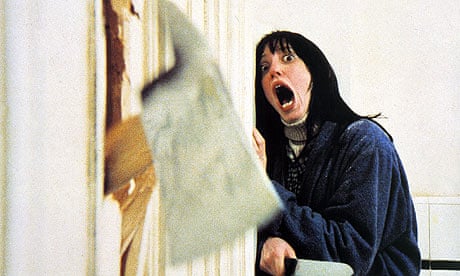
It's easy to forget, but at this late point in the film
Wendy still has no clue the Overlook Hotel is haunted.
PT shares a similar narrative backdrop but skips the main family narrative. Instead, we play as Norman of Reedus, a man among men who should, but can't, punch ghosts in the face. The ghosts of PT aren't tangible threats; I brought up The Grudge for a reason, as the vengeful spirits are similarly unstoppable forces of nature. The difference in Jack and Kayako is the human element: Kayako is an unkillable monster, a spirit forced into undeath by the hateful curse of the husband that murdered her. On the other hand, Jack is a human; he's tempted by human demons and is dispatched in a human manner. The difference between PT and Resident Evil VII is that, with a human enemy, the player or protagonist is capable of eventually overcoming them even when faced with low odds of survival. With a ghost like Kayako or Lisa, the outcome is either to accept your fate (the former) or run like hell to escape.
What I really like about PT is that the unkillable, unstoppable ghost is not there to initially kill the player. It merely wants to help them escape until it feels threatened. As the player proceeds through the nightmarish, continuing hallway of the house--a horrifying and non-euclidean descent into madness reminiscent of the post-modern novel House of Leaves (which also shares narrative similarities with The Shining) they are eventually locked in the bathroom with yet another horror reference, this time to David Lynch's masterwork Eraserhead.
The Horror of Failure
Eraserhead is a difficult movie to parse, and even more difficult to discuss without either spoiling it or failing to present the film in a cohesive manner. It's largely visual and is full of allegory and symbolism. It's profound while being incredibly personal, and I won't pretend like I fully grasped the concept the first time I saw it as a teenager. After coming back to it a few years later I felt like I appreciated it much more, and at this point in my life it's become something of a goalpost for existential despair that's as haunting now as it probably was to people who saw it years ago. It resonates with anyone who's ever feared failure, but as a reversal to the fear of family; it's a fear that one's ineptitude for family, of growing up and settling down, will lead to the decay of ego and eventually life itself.
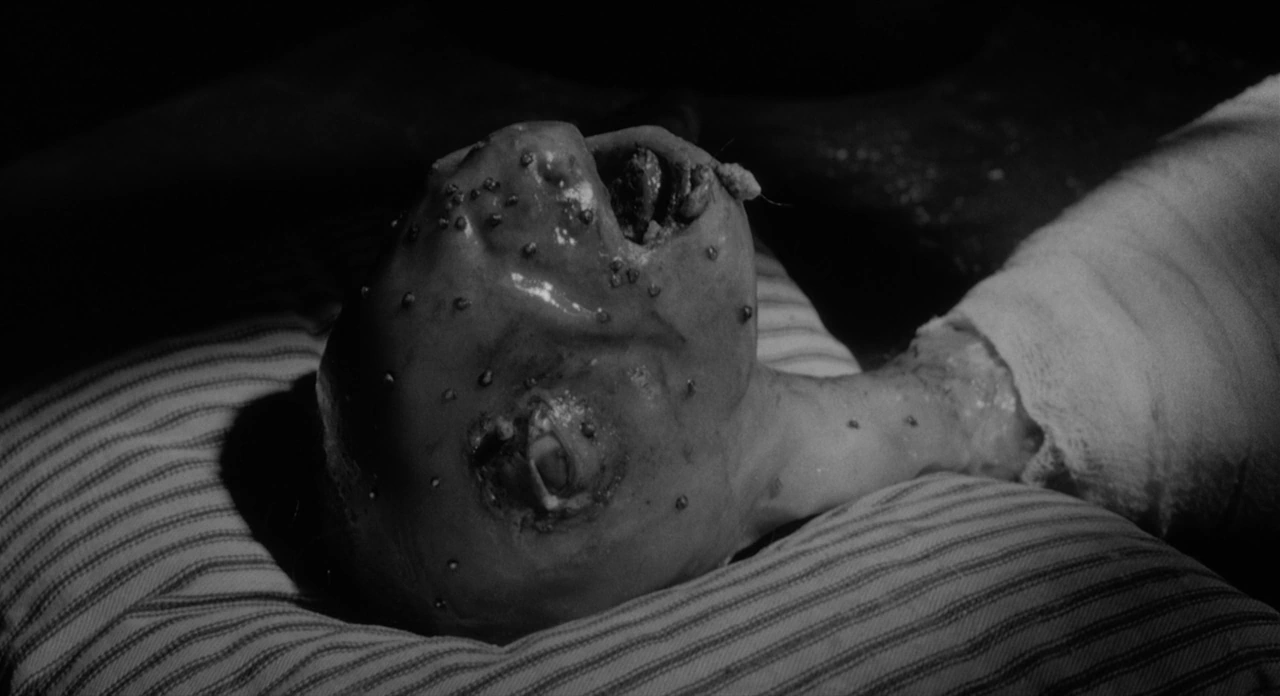
This little jerk is not only a terrifying image in itself, he's also associated with all the negative elements of the film. Growing old and sacrificing your health, your personal relationships, and becoming a worthless cog in an unfeeling machine are all big parts of Eraserhead, and they all come back to this cruel sack of meat. The film's protagonist, Henry, is forced to take care of The Baby after his wife is driven insane by it and in turn begins to lose his mind. The baby taunts him in its own weird way and causes Henry to feel guilt about leaving it. At one pivotal point in the film, and what I consider to be the turning point of Henry's character, he attempts to finally tell the Beautiful Girl Across the Hall (that's her name) how he feels after having sex and losing contact with her at an earlier point in the film. When he does so and finds she's with another man, he briefly, and crushingly, sees himself the way she has since their encounter:

The crossed line, it should be pointed out, is that Henry himself has resigned himself to failure. In an effort to destroy this failure, he murders the baby--his identity--and crawls into the loving arms of the only woman who will accept him: The Lady in the Radiator.
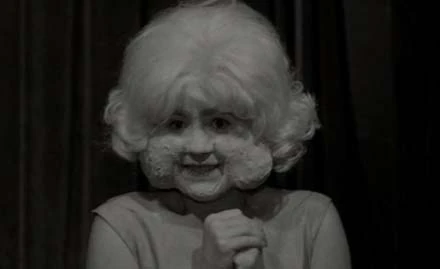
Hot. Because radiators are very warm, get it? Huehuehuehue
The Lady in the Radiator might not be what many consider the ideal partner. She's hideously deformed, and also she lives inside a radiator. She's no Beautiful Girl Across the Hall, that's for sure--oh, and she's not real. But stuff like beauty and reality don't really matter much for the tortured Henry Spencer, all he wants is someone who will accept him and welcome him with loving arms. Even if she does sing about taking him to heaven and smashing sperm-like creatures: Henry doesn't care about stuff like masculinity or even life, he accepts failure graciously after fighting it so long throughout the film.
So what does this all have to do with the horror masterpiece PT, exactly? Forget that little detail? Well, not much, except for this:
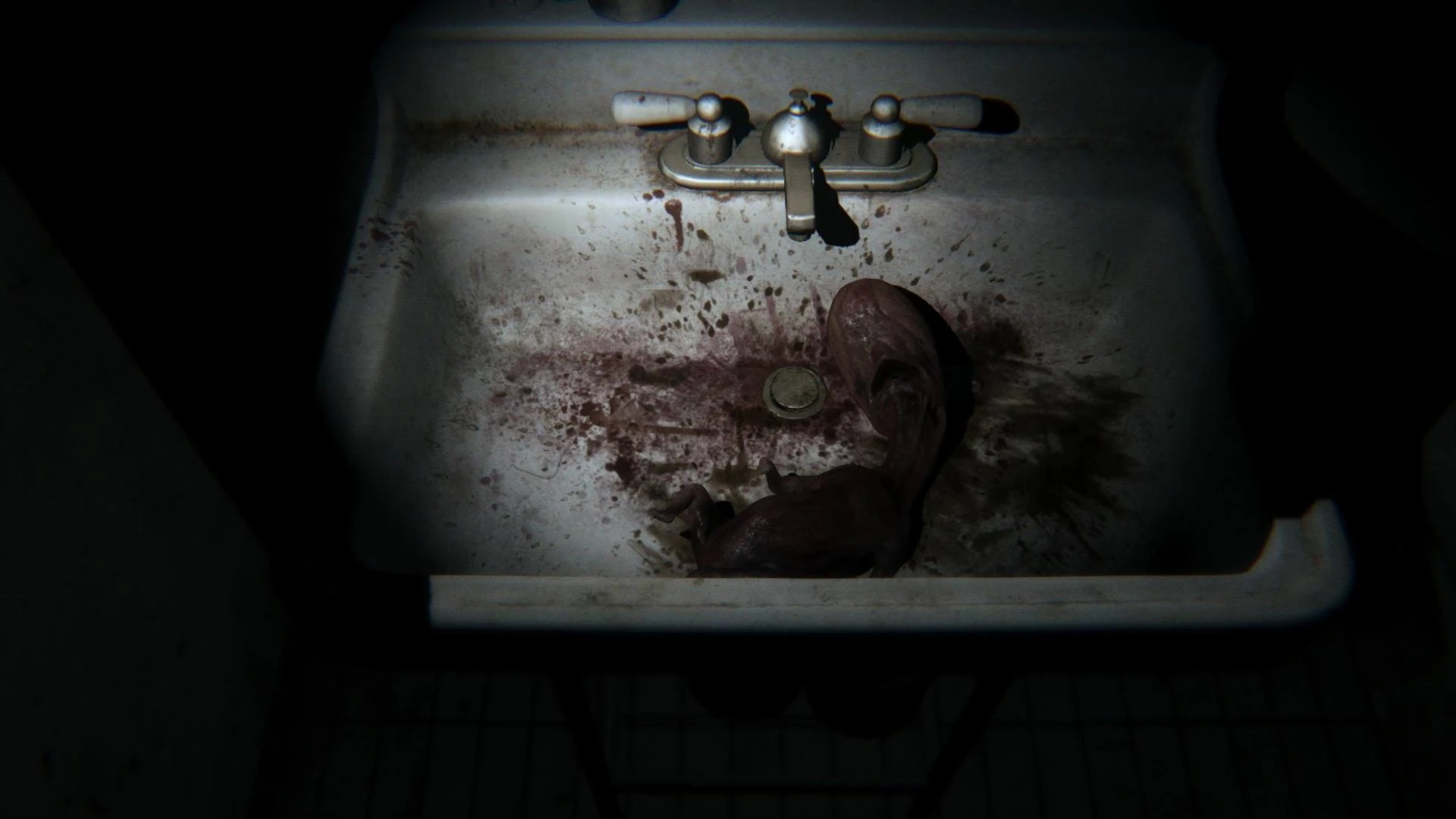
Anyone who had seen Eraserhead before playing PT were likely in for a pleasant surprise upon discovering this pitiful creature in the sink, but it's not clear (and never will be) if the baby is a villain in the vein of Henry's Baby or just a benevolent ghost. It assists the player in escaping the house, but many players might simply take a look at the creature and accept it as it appears. I think the visual allusion to Eraserhead might help in interpreting the patriarch of the family, as well. To go further with this, here's a quote from the baby further into PT:
"You got fired, so you drown your sorrows in booze. She had to get a part-time job working a grocery store cash register. Only reason she could earn a wage at all, is the manager liked the way she looked in a skirt. You remember, right? Exactly 10 months back."
So is the father merely a remorseless murderer who isn't worth our sympathy? I wouldn't be so quick to judge. Much like Henry, the unnamed patriarch of the family faces a deep pit of despair, having been laid off from his job and watching miserably as his wife is the only person in the family making any money--a fact which he believes directly correlates with his wife's pregnancy. That's not to say he's not the father, but in his mind the threat of failure--failure at life, of being a father and husband, at losing the ability as an independent individual--all culminate in the quickening of Lisa's pregnancy.
The horror of failure isn't one which relies too heavily on an outward fear, but rather of internalizing the failure of the subject of the story. The patriarch of PT considered himself a failure much like Henry Spencer, the climax of whose arc culminates in the murder of his infant whatever-it-is. Coincidentally, The Shining's Jack is something of a failed writer, his severe writer's block being the primary cause of anxiety which leads to his Faustian deal later in the film. This even extends to the other film I mentioned, The Grudge, in which Kayako's husband brutally murders her, their son, and their poor innocent cat after discovering Kayako is stalking another man. Even the threat of the loss of masculinity can be perceived as a failure, and for some of these characters that's all it takes to spiral into destructive tendencies.
That's not to say we should totally sympathize with many of these characters--for some, namely the villains of The Grudge and The Shining, it's very difficult to see them as anything but psychotic murderers. The fear that arises from these characters is the razor-thin line of sanity which these characters stepped over after accepting their own failure. The victim of this horror is rarely ever the one who has failed; Henry is something of an outlier in this group since the outcome of his failure, a creature his wife's doctors say is not even human, is the one tormenting him. The viewer instead sympathizes with the victim, who often is punished for a paranoid delusion. Neither Lisa nor Kayako were stated to have actually done anything, but still met with a grisly fate.
The Horror of Horror
According to the website LiveScience, horror stimulates a reflex that has kept humans alive since the stone age: the acute stress response. If you're a dullard, this refers to the fight-or-flight response, the defense system that sends our minds into an over-active state, heightening one's senses long enough to either run away from, or punch satisfactorily, a perceived threat. What makes horror so effective is that the brain knows its owner isn't stupid (in most cases) and, to take the words of LS, "experiences this adrenaline rush as enjoyable."
The most important factor in horror, and the most difficult to pull off, is to set the participant's mind into that state and pushing them past the stimulus to achieve victory. The difficulty comes in depowering the protagonist in order to maintain the fear response, but because advances in modern film- and game-making, it's become easier than ever to mistake "shock" and "horror."
I want to use two recent movies as an example: Paranormal Activity (I don't care which one you pick) and Eli Roth's The Green Inferno. One of these has more sequels than it knows what to do with, and the other had to fight to even get a wide release. Guess which one gets overlooked in discussion?
Paranormal Activity tricks the audience into a fight-or-flight response by marketing itself as "that one movie what makes you jump bad." But seriously, all of its marketing relied entirely on showing audience members jumping and screaming like morons being paid to overreact to a movie--sorry, I mean like just average morons. When you go into any of these movies you know exactly what's going to happen, and the whole time you're going to be on edge because you know the loud crash will pop off after several minutes of silence. The most effective scene in any of the Paranormal Activities I actually watched--which admittedly aren't many--is from the first movie when the haunted girl gets out of bed and stares at her boyfriend. It makes my skin crawl and part of that comes from the fear of the familiar, of sympathizing with the girl who is unfairly haunted and her boyfriend, vulnerable and at the mercy of the demon. The scene goes on for an agonizing minute in real time (two hours, according to the movie)--and for a film as short as the first Paranormal Activity with every second being precious, an entire minute with something like this is downright terrifying.

But seriously, I need to stop writing these at night.
Those movies are cheap "jump scare" factories. You don't go into them to sympathize with a troubled family or reveal truths about yourself, you go there to jump in your seat, laugh it off, then go home to your sad life. Every single one of these movies is the same: innocent family gets haunted and it gets progressively worse. But diminishing returns are important in any movie, so when you have seven films (I'm looking at you, Saw) with the same gimmick and emotional payload, your brain just stops caring. To go back to that LS article:
"'In these cases, those engaging in high-risk activities will tell you that the risk is lowered by their training and precautions,'" enabling them to enjoy the experience, Rudd said. The key structure in the brain responsible for this effect is likely the amygdala, he added, which is key to forming and storing memories linked with emotions."
If you keep shoving this crap at your viewer they're going to stop caring; you can perceive in real-time the slow degradation of these films as a passion project into a machine, churning out the same miserable experience. If you ever wondered what "soulless cash-grab" meant, here you go, this is the dictionary definition of the term. It's the reason I'm so fond of a one-off movie or video game; it's also why I stay glued to a television show like Game of Thrones--which has a clear story charging head-long into its inevitable conclusion--as opposed to The Walking Dead and the showrunners' promise of "continuing until we can no longer film" or whatever they said. I've long since stopped caring. We all want closure, a denouement that wraps the story in a neat bow. It dilutes the original vision when a simple project is turned into a self-proclaimed "saga" with no end in sight, propped up by a shameless gimmick.
On that note, The Green Inferno is very firmly a one-and-done ordeal, and I don't want to spoil it too much because I desperately want others to just watch it as soon as possible. If you aren't aware, in this film a bunch of whiny internet activists decide to do something important for a change--signifying that the movie is in fact fiction--and protest a logging company destroying land in South America. The plan goes awry and the students are held at the mercy of an indigenous cannibal tribe.
The horror of the film comes primarily from sympathy, but it's also hard to fully hate the tribe given that they're still extremely primitive. The students actually attempt a noble cause and the horror that awaits them is not only shocking, but heart-wrenching. The climax of the film is one of the most tense moments I've had in recent years of film, and without giving it away let me just say it's not exactly something a man would typically need to worry about. Rather, the threat comes from genuine tension and fear for the character. While Green Inferno doesn't try to shy away from startling its viewer--you like eyeballs?--it also doesn't attempt to do so in a cheap way akin to Paranormal Acitivity. It sets up its laughably simple plot, establishes the characters, and descends into a maddening crescendo of violence and horror until its conclusion.
To bring my point back around, these two films engage the audience in different ways that involve depowering the protagonists, and ultimately the viewer. For Paranormal Activity, the protagonists are mostly depowered in the simplest way a haunting movie can achieve: they're humans, ghosts don't care about the laws of physics, people get terrorized until the climax. The true depowering comes from the viewer, who has no recourse but to passively watch the action. In order to maximize the fear, these films take advantage of the passive state of viewing and take cheap shots at the audience, shocking them with loud noises and sudden visuals. There's very little memorable here, least of all the experience of watching the movie. I don't know about you, but I take a lot of stock in what movies can hold my attention and which are just wastes of time and spending ninety minutes on edge that I'll be annoyed into a fear response does not make for a memorable movie.
On the other hand, the protagonists of Green Inferno are depowered by being mobbed by a tribe of savages (literal, not metaphorical) who proceed to eat, torture, and rape the cast. The film relies on lingering imagery and shocking visuals while establishing a very real threat: this is tonally a horrifying movie, and the gore is merely window dressing. It doesn't resort to loud noises and jump scares to affect the audience, instead focusing on the strength of its laughable script and direction to create an experience the viewer will remember. When you revisit a Paranormal Activity, you know where the gimmicks are hiding. You can see the man behind the curtain, whereas in a movie like Green Inferno it's, well, a movie. It's not a theme park ride, it's a story with characters, themes, and a story.
But both of these movies pale in comparisons to the legends mentioned earlier. Eraserhead, The Shining and even The Grudge are still being discussed today, especially the earlier two, and part of that legacy stems from the masterful presentation of those films. There are massive layers of subtext, and in the case of Eraserhead the film's obscurity is so well-crafted that it begs, pleads for the viewer to give it a unique interpretation. If I went back to The Shining right now I assure you there's something new I'd pick up that I never noticed in a prior viewing--in fact, just in writing this post I realized that Wendy didn't even realize the Overlook was haunted, and that to her Jack's meltdown was just an inevitability. That picture you saw earlier in the post? Yeah, that wasn't part of my initial analysis of the film. But wait, wasn't this all supposed to be about video games?
The Horror of Video Games
I will never play Gone Home again. I didn't know what I was getting into at first, but after about fifteen minutes of playing and realizing the spooky atmosphere was entirely wasted, I started to notice the seams. While I was hoping for a send-up to games like Clocktower or Alone in the Dark, instead I found myself dumped into a sterile, lifeless house that didn't react to a thing I was doing and lazily threw me into a melodramatic story that had the pretension to tell me to piece together its own plot, as if I had nothing better to do.
See, I view replay value--or, if we're still talking in movie terms, a movie that can be watched again and again--as one of the most important elements in game design. Sure, the plot of Zone of the Enders 2 is laughable at best, but when I can play through a unique high-speed mech game in two hours then why wouldn't I want to try it out on higher levels? Action games are rife with replay value, such as Devil May Cry 3 and 4 or Ninja Gaiden. You may not realize it, but this also applies to Resident Evil and Silent Hill in their own special ways.
For the former, the player is under constant scrutiny to hurry through the game indirectly. Completion can unlock new rewards for a second playthrough, and an excellent playthrough can allow the player to earn new toys or even new challenges to give a new spin the next time. Resident Evil is the root of all stylish action games whether you like it or not, and this has been apparent since the first game in the series. This sort of replay value is aimed at the game player, one who wants to experience a video game first and foremost.
Silent Hill takes a more film-like approach to both its story-telling and replay value, although it doesn't skimp on the gameplay. Because I'm an obnoxious tool and apparently a trend-follower, I'll use the second game in the series as my example here. The last time I played Silent Hill 2, I took a route backward I had never thought of before while exploring the end of the game. I hadn't thought to check the lower floors of the hotel before after it became flooded, but something compelled me to this time. Somehow, in my years of this being one of my favorite games of all time, I completely missed a conversation between James and Mary's doctor which opened an entirely new interpretation of the story to me. In my playthrough before that, while searching through the same area I noticed the furnace in the hotel had "my name is Jack, I'm one hot guy!" etched into the side. While not a major detail, I was delighted with the nod to The Shining, even if it was the inferior novel to an extraordinary film (Eat shit, Stephen King. That movie salvaged your terrible novel). As a reward for merely having read that book I immediately could piece together the cause and origin of the fire which destroyed the hotel, and had I not attempted to replay the game with exploration in mind I would not have found it.
And that's not even to mention the multiple endings of Silent Hill 2, which this post absolutely cannot contain on its own. Silent Hill 2 shifts and molds its endings based on the way the player not only interacts with the world, but how they interact with themselves in the world. It's a brilliant bit of postmodern storytelling in games, and one which seamlessly takes player choice into account while tallying up points for one of six endings tailor-made for each individual playstyle. One of these endings can only be achieved in a second game and even then requires a great deal of attention and exploration.
It's strange, then, that both of the teasers for Resident Evil VII and the aborted Silent Hills use the formula of the latter in their design choices. Resident Evil VII's demo, for instance, changes up as the player breaks sequences within the game, offering new variations of the ending and even opening new areas to explore. While PT doesn't offer particularly different outcomes, it instead has multiple fail states, puzzles, and different variations of the ways in which Lisa can haunt the player.

A rare appearance from Lisa, one which
made me prematurely end a run of the game.
The primary concern of a horror game, then, is to simply not be a Paranormal Activity. While you could make a (flimsy) argument that PT and Resident Evil VII seem to be following this trend of first-person jump-scare games, the truth of the matter is that both of these games borrow primarily from higher, more elevated inspirations. Both of these titles aim to immerse the player not in cheap scares but in building a world that can only be accomplished through video games.
As of this writing, a number of players are scrambling to find the meaning behind an innocuous mannequin finger in the Resident Evil demo. Nobody knows what it does, but the mystery is part of an experience unique to video games. Exploring the house in the game could lead to the player being "welcomed into the family" with any wrong move, which is considered a fail state. In the same vein, PT offered several riddles to solve, some easy and some a little more obscure. If the player roamed the halls too much or "cycled" through the never-ending hallway, Lisa would be lurking in the hall and give a fail state of her own. As mentioned earlier, horror predominantly aims to present its audience with a fight-or-flight response, and video games, giving direct input to the player and offering them the choice to fight or flee, might be the perfect venue for horror to thrive.
I could go on . . .
I've been sitting on this blog for a few months, unsure whether or not I want to release it as it's mostly a jumbled mess of ideas--as the title states, it's basically just me gushing about why I love horror so much. However, I'm about to move and won't have a chance to write a blog for a while and after re-reading this piece, I'm fairly happy with it. Given the date, I also think it would be nice to have a horror-themed blog. You know, it's almost Thanksgiving. The horror behind snapping a turkey's twig neck and listening to your family talk about how much they hate everything and everyone makes it truly one of the most horrifying times of the year.
Happy Halloween!
